Since the Mendelson family took it over in 1990, Heico has grown into an aviation and aerospace giant
It’s one of the most successful companies in South Florida, a family-led business that has been growing by double-digits annually, is beloved on Wall Street, and this year will near $4 billion in sales, while employing some 10,000 people across the United States and five continents.
Yet few in the general public are familiar with Heico Corp., which has dual headquarters in Broward County’s Hollywood and in Miami. That’s because the fast-expanding manufacturer sells largely to airlines, satellite makers, and aerospace companies, not to retail consumers.
Heico produces replacement parts and components for jets, satellites, and other equipment. It reverse engineers the parts made by brand-name giants like General Electric – and in a rigorous process, obtaining certification for those parts from the Federal Aviation Administration (FAA). It then sells the parts to customers like Delta Airlines at prices cheaper than the original equipment makers, while earning a solid profit. With those profits, it reinvests to reverse-engineer more parts or buy up other niche parts makers, keeping business compounding year after year.
When the Mendelson family took over in 1990, Heico made just one FAA-certified part in its sole Hollywood factory. Now, it offers more than 200,000 products at dozens of factories worldwide, with hundreds of thousands more items still available to add to its portfolio, executives say. Last year, it completed its largest acquisition yet: the $2 billion purchase of Wencor Group, based in the Atlanta area, which makes complementary products for aircraft, including bearings.
How did a family-led business achieve such remarkable success, with its stock on Wall Street now commanding a market value topping $28 billion? Credit strong business education, attention to detail, family unity, careful vetting before buying companies, trust in managers, and care for employees, among other factors, say the Mendelsons, stock analysts, workers, and others familiar with Heico.
“When we’re on the beach, these guys are on their laptops. They’re hard-working people,” says factory worker Guillermo Evia, who joined Heico a half-century ago, before the Mendelson “guys” came in. “When I began here, if we did $1 million in sales [annually], we had a party. Now, we do $1 million an hour, and some employees are worth millions too,” thanks to Heico stock the Mendelsons put in worker retirement funds, says Evia. “I feel good working here.”
Chairman of the Board Laurans “Larry” Mendelson credits the same features in weighing Heico’s acquisitions: A venture that is entrepreneurially led, owner-run, and has a long-term outlook in a niche business. “It’s all about management,” he says. “It’s all about the people.”

HOW HEICO STARTED
The idea behind Heico came from two brothers, Victor and Eric Mendelson, and their accountant-investor dad, Laurans – all graduates of Columbia University in New York and longtime South Floridians. In the late 1980s, while studying and dabbling in investments, Victor saw opportunity in buyouts. He heard about struggling Heico Corp. through a stockbroker. He and Eric approached their father, who agreed to buy up the company’s stock on Wall Street. Soon, the trio took management control. They agreed to make their decisions unanimously and focus on the long-term for future generations.
Like commercial aviation itself, their business was global from the start. German airline Lufthansa became an early buyer of the FAA-certified parts and became an investor, boosting Heico’s credibility.
The Mendelsons focused first on reverse-engineering parts for jet engines, selling its FAA-certified items at 25 percent to half off the price of original equipment from makers like GE. With little competition because of the rigors of FAA approval, they could draw solid profits of around 15 percent, while still taking care not to gouge airline buyers or to take away too much market share to anger the brand-name giants.

“We don’t target the top line” of sales revenue, says Larry Mendelson. “We can do a trillion dollars in sales and make no money. We are focused on the bottom line and particularly cash flow. That allows us to keep low debt and keep compounding the earnings. It’s the power of compounding that has made us,” he says. In acquisitions, the family also looks for fellow niche companies with strong profits and cash flow. “And you get that in a protected market, with high barriers to entry.”
MANAGING OPERATIONS IN 19 COUNTRIES
Today, Heico makes a wide range of products in 19 countries, from jet-engine parts to electronics and airframe components. Its factories span nations as varied as the Netherlands, Thailand, India, Canada, Turkey, and the United Arab Emirates, thanks to its many acquisitions. France is its second largest production center after the U.S. and hosts at least 10 factories, says co-president Eric Mendelson. Being global requires ample travel. Eric Mendelson says the family always traveled a lot, “so we’re comfortable in different cultures. And we grew up in Miami, so we get that.”
To expand overseas, the Mendelsons have focused on buying entrepreneurial ventures like their own. They typically let the owner-managers abroad keep a 20 percent stake in their ventures and continue running operations, creating a decentralized network of businesses under the Heico umbrella.
“We didn’t find a greenfield site in a foreign country and just assume that because we’re successful in the U.S. that we can operate overseas,” says Eric Mendelson. “So, we’ve developed partners around the world that continue to build and grow.” One acquisition in France recently added two factories there. Adds co-president Victor Mendelson: “We let our businesses operate locally. We’re not trying to run them from here. They know how to deal with their environments and governments. We don’t dictate.”
GOING HIGH-TECH IN SOUTH FLORIDA
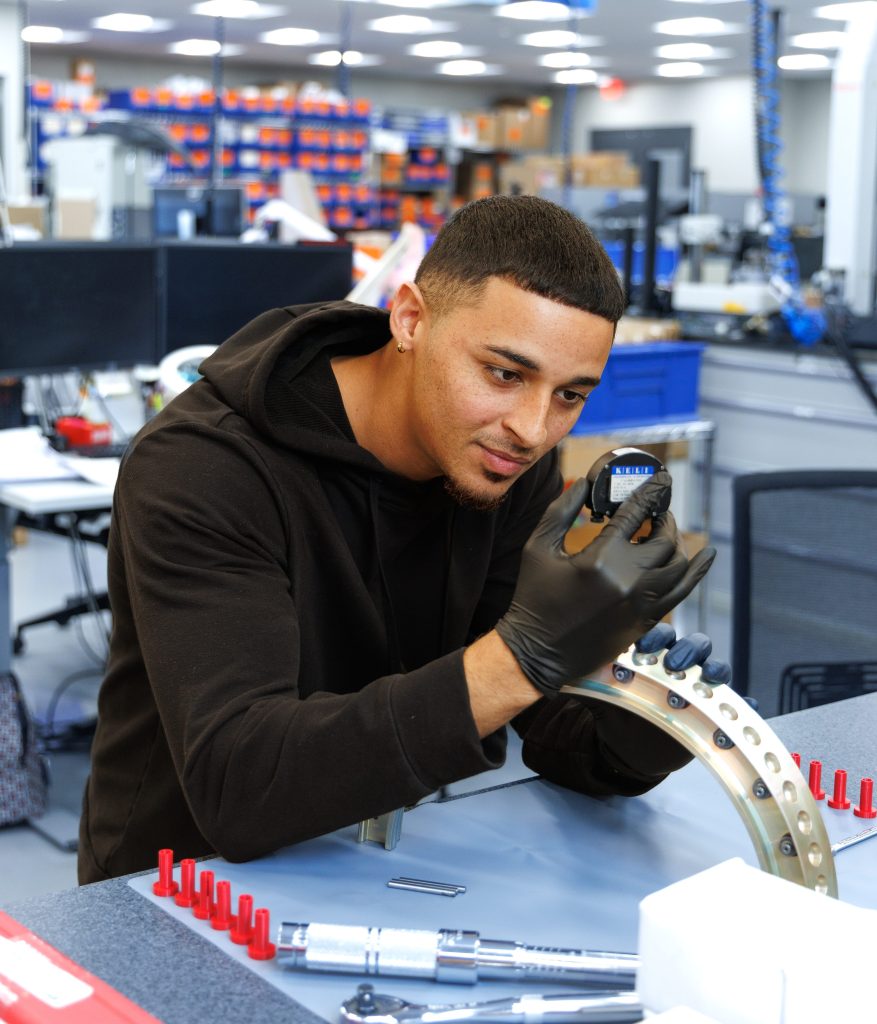
In South Florida, Heico now employs some 1,000 people, including 200 engineers. Most staffers work at its aircraft maintenance and repair operation, some at its Miami office, and about 100 at its original Hollywood factory. The factory staff has been shrinking, as South Florida costs have spiked and production has become automated. Today, the Hollywood plant uses sophisticated and expensive machinery, including a 3D scanner with powerful cameras that measure the height, width, and depth of parts to be reverse-engineered or inspected.
“We scan parts as big as a car or as small as half an inch [with specifications] more accurate than the area of a human hair,” says factory employee Luis Cuevas, who has worked 20-plus years with Heico, adapting over and over to the latest technology. “Every day is something new.”
Across greater Miami, manufacturing is becoming more high-tech, says Matthew Rocco, president of the South Florida Manufacturers Association. South Florida hosts some 6,000 manufacturing companies that employ roughly 100,000 people, according to a 2023 Florida Manufacturing Report by Florida Commerce. Aviation and aerospace hold an outsize share, partly because of Miami’s role as a hub for flights to Latin America and the Caribbean, Rocco says.

With automation, many South Florida manufacturers now pay salaries higher than in other sectors, often $70,000 or more per year, says Rocco. The challenge, however, is finding skilled staff. Some trained employees see opportunities in areas outside South Florida where housing and insurance cost less.
“We need more skills training, so companies like Heico can have talent more readily available,” says Rocco. “It will take a stronger joint effort from organizations like ours and colleges to produce skilled workers.”
HEICO, FEATURED IN FORBES MAGAZINE
Amid the challenges, Heico keeps growing sales and profits, and Wall Street adores it. Forbes magazine featured the Mendelsons in a 2020 cover piece: “The 47,500% Return: Meet The Billionaire Family Behind The Hottest Stock Of The Past 30 Years.”The article says the Mendelsons have “succeeded in unquestionably spectacular fashion.”
Since then, Heico’s financials and share price have gained handsomely. The company reported a 20 percent gain in net income in the first half of this fiscal year from a year earlier to reach a record $237.8 million. Noted investment group Berkshire Hathaway, led by Warren Buffett, bought a small stake in Heico in the second quarter.
Still, there are questions about the company’s future. How long can Heico keep up double-digit growth, now that it is so big? And can the Mendelsons sustain their family-oriented, entrepreneurial culture as Heico’s global sales top $4 billion?
Larry Mendelson is bullish, at least for the short term. He sees aviation and aerospace continuing to expand worldwide, requiring more replacement parts and components. Plus, Heico has myriad items yet to manufacture. “I’ve never been more optimistic about the future for Heico because of the strength and size of the company and its market power,” says the industry veteran. “In the current fiscal year, I feel highly confident we will be able to grow at our target of 15 to 20 percent bottom line.”