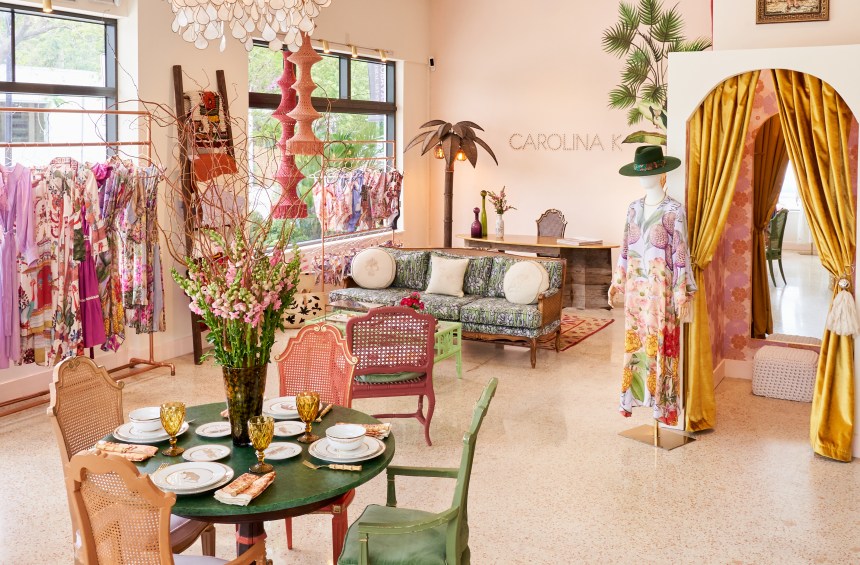
Argentine Carolina Kleinman shares her brand with artisanal creations from around the world
Walking into Carolina K’s flagship store in Miami’s Design District, the first thing that might catch your eye is the red crocheted maxi dress with cascading ruffles. The tag reveals it was crafted by an artisan from Mexico named Elena. If you wander the store, you will see works from other artists and artisans across the globe, all curated alongside Carolina Kleinman’s own designs. The store is a patchwork quilt of cultures, showcasing creations from countries like Peru, Mexico, Argentina, Colombia, Ecuador, Cuba, Portugal, Guatemala, India, Morocco, and more. Even a coastal blue and white jumpsuit from Kleinman’s summer collection uses a print designed by French artist Henriette Arcelin, hanging not far from coral-inspired art by Miami-based Brazilian artist Beatriz Chachamovits.
Kleinman’s Carolina K store in the Design District opened earlier this year, the culmination of her brand basing itself in Miami, which began in 2016 with a shop at Miami Beach’s posh Faena Hotel – the year she decided to make Miami the headquarters for her label. After maintaining that shop for five years and integrating herself into Miami’s budding fashion scene, Kleinman opened a studio in the city’s Little River district in 2021. The opening of her flagship Design District store in April, where she could showcase both her clothing and curated collections, felt like the natural next step.
Kleinman’s journey in fashion began long before her arrival in Miami. The Argentine designer recounts being surrounded by fashion since she can remember. “I grew up in fashion. My mom had clothing stores when I was little, and later I found out that my grandfather was in textiles and trims… It all just came very naturally to me.”
After launching her label in 2005, Kleinman spent the next eleven years living and traveling throughout Central and South America while building her brand. These travels remain a significant source of inspiration for her designs, and just as importantly, her commitment to slow fashion – the practice of sustainable, ethical clothing production that prioritizes quality over mass production and takes into account the impact on the environment and workers. Part of that, for Kleinman, is the curation of artisan-made items.

Even though her designs are now featured in major luxury department stores like Saks Fifth Avenue, Kleinman says her focus has always been on sustainability, even before she was fully aware of it. “For many years, I never thought of the term sustainability. From the beginning, everything was made by hand. We had about ten years where each and every piece was made by hand, and there was no waste,” she says.
But when she expanded her label in 2014 to include prints, Kleinman had to rethink the process. “We scaled the business and started doing prints. Of course, there’s waste with that, and depending on where the material is grown, it might not be sustainable. So, after doing a lot of research, we found the right materials. Now we only use fabrics that are made in an eco-friendly and responsible way,” she explains.
Kleinman’s commitment extends beyond sustainability to preserving artisanal traditions. When she first considered creating her own brand, she was inspired by the markets near her hometown in Argentina. “When I went into these markets, I saw that a lot of these techniques were fading away. I was afraid some would be lost forever, so I thought, ‘Well, if I ever have a fashion brand, I’m going to make it meaningful. I’m going to preserve heritage.’”
Now, with her store in the Design District, Kleinman can display and sell products beyond her own label. “I love curating other brands, and not only empowering the artisans through Carolina K but also empowering like-minded individuals,” she says. “The store gives artists another platform to showcase their work.”
With its rich cultural diversity, Miami seems like the perfect place for this vision, and it’s hard to find a design label or fashion outlet in the city that captures its multicultural spirit better than Carolina K.