How a Miami-Based Biotech is Revolutionizing Regenerative Medicine
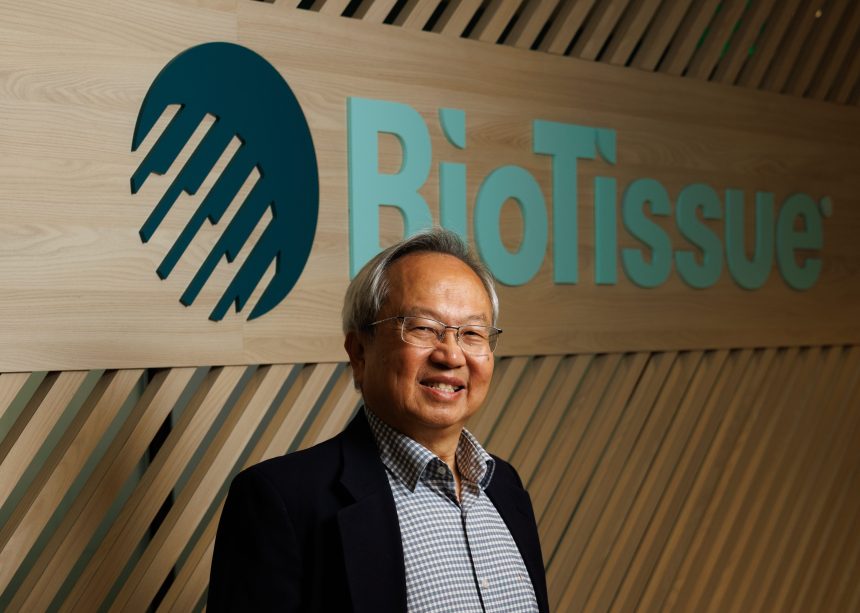
In a quiet office just off the runway at Miami International Airport, Dr. Scheffer Tseng speaks humbly about his decades-long mission: to bring regenerative medicine from the lab bench to the bedside.
At 72, the ophthalmologist-turned-biotech pioneer remains at the forefront of innovation, focused not on accolades, but on healing what many believed could not be healed.
Tseng is the co-founder and Chief Scientific Officer of Bio-Tissue, a company he and his wife launched in 1997 to translate decades of research into practical therapies. Their breakthrough? Using amniotic tissue, donated after childbirth, to treat everything from chronic eye disease to diabetic foot ulcers.
Originally trained as a physician in Taiwan, Dr. Tseng moved to the United States in 1978 with no plans to become a scientist. “I never thought I had talent in research,” he recalls. That changed during his Ph.D. at UCSF, followed by clinical training at Johns Hopkins and Harvard. By the time he joined Bascom Palmer Eye Institute in Miami in 1986, he had already begun to explore the regenerative potential of the human amniotic membrane.
What began as an experimental approach for treating severe chemical burns of the eye has since evolved into a platform technology. “The mechanism is the same across many diseases,” Dr. Tseng explains. “Chronic inflammation leads to scarring and tissue loss. Our goal is to interrupt that process and restore function.”
In 2002, Dr. Tseng left his faculty post to focus full-time on Bio-Tissue. The Miami-based company now has more than 330 employees and multiple facilities, including a 20,000-square-foot R&D lab and a nearby cleanroom manufacturing site in Doral. Roughly 100 employees are based in Miami, the remainder dispersed across the U.S.
Though no longer involved in day-to-day commercial operations, Dr. Tseng still oversees research. That focus has paid off. Dr. Tseng held continuous NIH funding for more than three decades – an almost unheard-of feat in modern academia. “One year, I counted over $15 million in total support,” he says. In 2015, the U.S. Small Business Administration awarded Bio-Tissue the Tibbetts Award, which honors firms that turn federal research grants into impactful innovations.
Much of Dr. Tseng’s success comes from a deep-rooted curiosity. In the early 1980s, he pioneered the transplantation of corneal stem cells from one eye to another, restoring vision in patients once considered untreatable. Yet it was the outliers – the 5% for whom the treatment didn’t work – that pushed him to explore amniotic membrane therapies.
His first paper on the ophthalmic use of amniotic tissue has since become one of the most cited studies in the field – and it was requests from fellow researchers for the amniotic tissue that led to the founding of Bio-Tissue. Since then, the use of the firm’s tissue pipeline has expanded far beyond ophthalmology. In addition to treating dry eye and glaucoma, the company is conducting trials for chronic wound care, particularly non-healing diabetic ulcers. “We’re not curing diabetes,” Dr. Tseng says. “But we are preventing amputations.”
While the company’s identity is firmly American, its roots remain proudly Taiwanese. Dr. Tseng maintains collaborative research relationships in Taiwan and is exploring the island as a future manufacturing site. “We are an American company, but many of us are Taiwanese descendants. That heritage matters,” he says.