


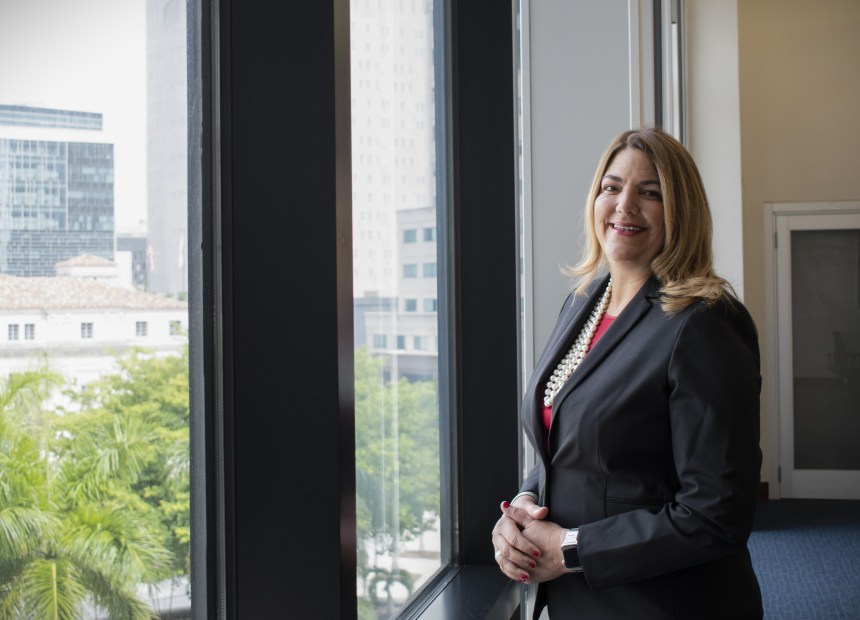
Madeline Pumariega links academia and business to prepare for Miami’s future
It’s Monday morning at Miami-Dade College, and an unlikely mix of people fills The Idea Center for the launch of a new business partnership. Gathered in one space are leaders of financial behemoths, entrepreneurs, corporate brass, elected officials, and lots of students. Once the DJ winds down the music, MDC President Madeline Pumariega takes the stage.
“Talent is universal, opportunity is not, and everyone in this room is sitting here because they had an opportunity,” says the 6-foot-tall trailblazer, wearing a red suit and speaking from the heart. She thanks everyone who’s helped build the new program of paid internships for MDC students, with $1 million in funding from JPMorganChase and Blackstone. Her view of developing local talent and the region’s economy is succinct: “We are stronger together.”
At the helm since 2021, Pumariega has been forging new alliances and programs at the MDC, the school of 125,000 students that ranks among the nation’s largest higher-ed institutions and certainly its most diverse. Associates call her visionary, student-centered, mission-driven, and genuine. She’s helped lift MDC to its best ranking yet: No. 4 among Top Public Schools in the South and No. 18 among all colleges in the South by U.S. News and World Report.
Pumariega puts priority on educating the workforce of tomorrow. To do so, she’s partnering with industry to better offer the skills that employers seek. She’s also introduced new studies, including the first full-suite of Artificial Intelligence credentials in Florida: a college-credit certificate, an associate degree, and a bachelor’s in AI.
For the 57-year-old from Hialeah, the role seems more a civic calling than a job. Pumariega adores the college where her Cuba-born mom learned English. She attended MDC herself and devoted 20 years to teaching and administration there – even creating The Idea Center – before leaving for top posts elsewhere in the state. Back at her alma mater, she’s committed to helping South Florida thrive into the future.
“We transform lives through the power of education,” Pumariega says. “When I look at my own life and where I’m at, it’s because of education. My mom was a school teacher, so I saw how teachers change lives. And I see when we have an educated workforce, we create communities of empathy, engagement, understanding, and collaboration.”
As a leader, Pumariega is not one to draw attention to herself. She often brings her team to meetings of the six-college academic council and regularly thanks associates for their work, says Dr. Paula Hopkins, an executive vice president of The Beacon Council.
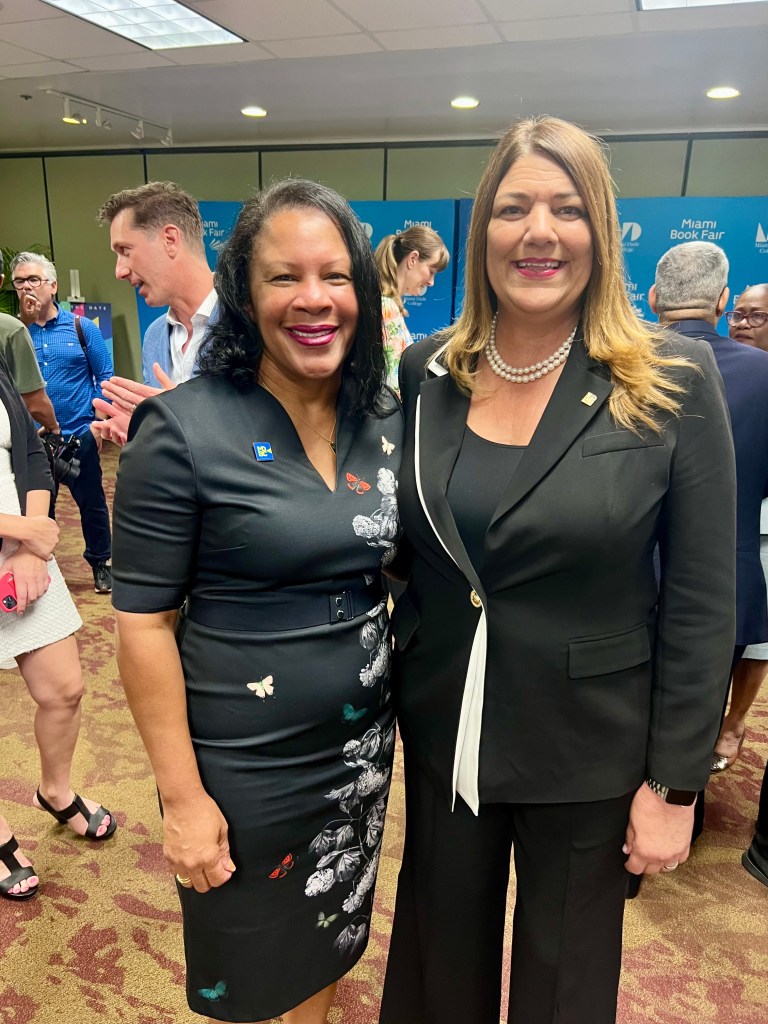
“When Jeanette Nuñez was named to lead Florida International University, Madam Pumariega was one of the first ones to reach out to her, and to say publicly, “You’re going to be successful in Miami, because we’re going to make sure that you’re successful,” says Hopkins. “In the Council, it’s collaboration over competition.”
Pumariega maintains an action-oriented mindset, Hopkins adds. “She has a sense of urgency. She mobilizes people. She always asks, “What’s next? How do we continue to drive momentum?’”
COLLABORATING TO MEET MIAMI’S WORKFORCE NEEDS
To partner with industry, Pumariega works on multiple fronts. Her team has set up business advisory councils for each discipline MDC teaches. They also ally directly with companies – with warehouse giant Prologis, for instance – offering internships to logistics students.

Pumariega also takes key roles at business-related groups, including The Beacon Council, Miami-Dade’s nonprofit for economic development. When Beacon launched Opportunity Miami to map the county’s future, Pumariega joined that program’s Academic Leaders Council and became its president. Last year, she helped set a hefty education goal for the county: to boost the number of adults with at least an associate degree from 45% to 65% by 2040, aiming to add billions of dollars yearly to the local economy. Miami-Dade lags both Florida and the U.S. in that metric by roughly 10 percentage points, studies show.
“According to Florida College Access Network, a person with an associate degree earns more than $70,000 annually, in comparison to $35,400 for a high school diploma. The average salary for a person with a bachelor’s degree stands at nearly $90,000,” Pumariega notes, in an article she co-wrote with Beacon Council CEO Roderick T. Miller. “An essential component in building talent is partnering with businesses to ensure that institutions of higher education produce the right credentials that align with workforce needs.”

CONNECTING WITH BUSINESS, EVEN OVERSEAS
The MDC chief also leads at the Greater Miami Chamber of Commerce, the century-old group known for missions abroad to expand international business. Fluent in Spanish, she took part in May in the Chamber’s 24-person mission to Buenos Aires, Argentina. There, she signed an accord for MDC to collaborate with business school Universidad Argentina de la Empresa (UADE), centering on student exchanges and sharing knowledge in AI and other fields.
“Because we’re Miami, our curriculum always has a global twist to it, whether its trade, logistics, culinary, or entrepreneurship,” she says.
In June, after years on its boards, Pumariega moved up to become the Chamber’s chairperson. Little wonder then that the World Trade Center Miami this year recognized Pumariega with one of its International Women’s Achievement Awards, honors offered since 2004 to area women fostering international business and economic development.
“As the first female president of MDC, she exemplifies the very spirit of the award – empowering others, expanding opportunity, and strengthening Miami’s international position through inclusive, forward-looking initiatives,” says Ivan Barrios, president and CEO of the World Trade Center Miami. He specifically lauds her efforts in AI and cybersecurity, “fields critical to the region’s future competitiveness.” What’s more, says Barrios, she champions international exchanges, “building a more connected, globally aware student body.”
PUMARIEGA’S PATH TO LEAD MDC
Growing up in Hialeah playing basketball, it was never a slam-dunk that Pumariega would run the region’s biggest college. Inspired by her mom’s love of education, she attended MDC partly on a basketball scholarship, then attended the University of Central Florida, and received her bachelor’s from St. Thomas University in Miami. She started her academic career in 1992 as MDC’s dean of student services, rising to become president of the college’s Wolfson Campus, where she introduced the Miami Culinary Institute, among other programs.
Later, she went north to the state capital. In 2015, she was appointed chancellor of the Florida College System, overseeing 28 state colleges, becoming the first woman and first Hispanic in that post. In 2019, she became provost of Tallahassee Community College. Those experiences in the capital, Pumariega says, helped build her political skills to better serve MDC now. “I think colleges have to have all those acumens – political, education and business – to be able to work with a diverse group of stakeholders,” says Pumariega. She’s confident that leveraging relationships she developed in Tallahassee “helps advance the mission of the college.” Inside MDC, Pumariega started out “re-imagining the student experience,” including quicker, more digital, and more personalized communication. “Uber has taught us that you can have a personal driver on your app in five seconds,” says Pumariega. “It’s important for the college to have students that can engage in that same way.”
Two examples of the digital push: Students previously applied to one MDC campus and waited to hear if they were admitted there. “Today, you apply to Miami-Dade College [online]. You select the preferred campus, [but] you’re admitted immediately,” Purmariega says. MDC also offers tutoring services online now, “so students can access tutors anytime, anywhere, versus just coming to campus if they need academic support.”
The school also has integrated tech more fully in the classroom, including AI. “We had 500 of our faculty back in the fall of 2021 go through AI training and workshops,” she says. “In 2022, we rolled out $100,000 in grants to faculty who would use AI in their curriculum. The AI academic program came in 2023.” In 2024, MDC also became the first college in Florida to have its AA and BA programs in cybersecurity validated by the National Security Agency. Of course, tech and markets evolve.
Pumariega says she’s now looking to boost offerings in quantum computing and in aviation and aerospace, sectors poised for growth in Florida. “The great [ice hockey player] Wayne Gretzky said, ‘Great leaders go where the puck is going, not where the puck is,’” she says. “We are preparing our students for the future of work.”
KEEPING COLLEGE AFFORDABLE, STUDENT-CENTERED
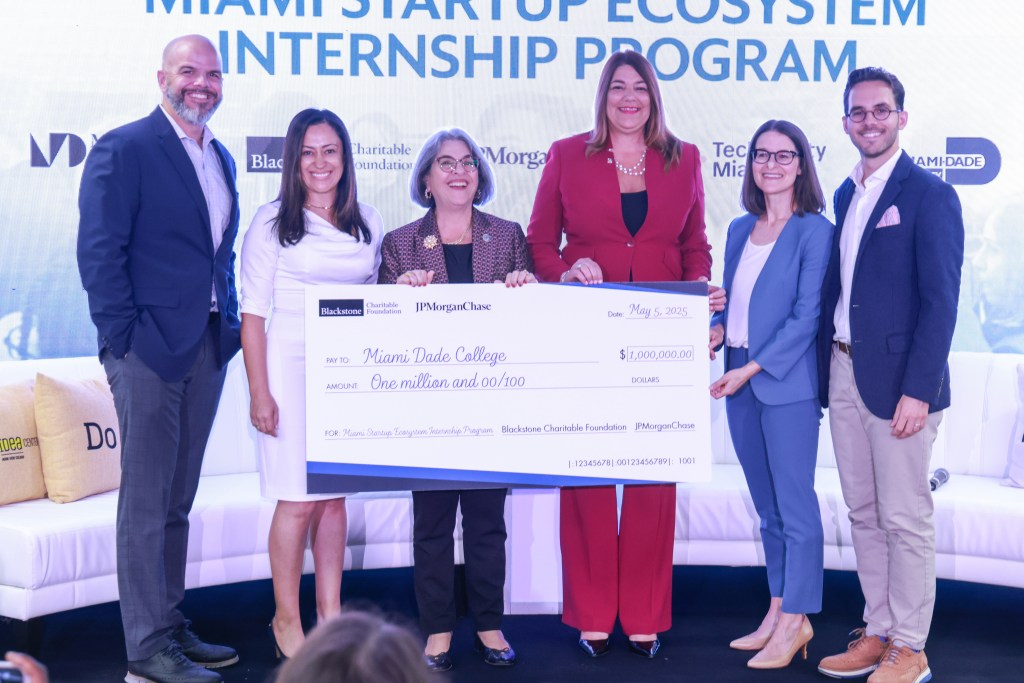
Pumariega feels strongly that a college education should be accessible for all. With costs for an MDC’s associate degrees at about $6,000, and a bachelor’s generally below $10,000, she’s glad that most MDC students graduate debt-free. She’s broadened MDC access too, with her Presidential Scholars Program that covers up to 60 credits for top high-school graduates in Miami-Dade.
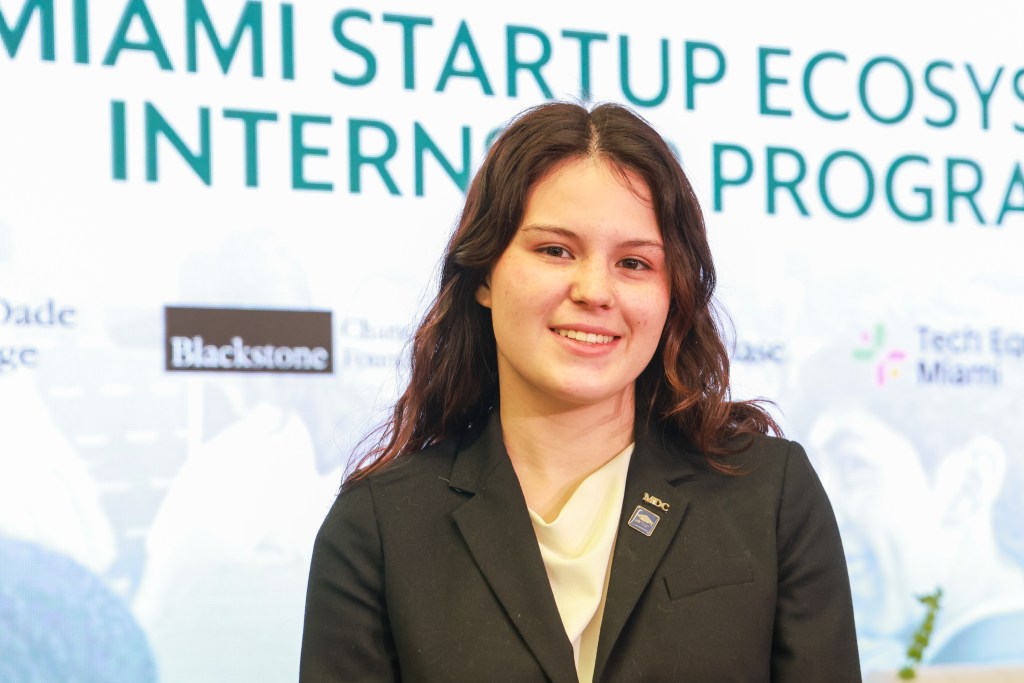
Mary Elizabeth Gomez, 21, qualified for a presidential scholarship and just earned her associate degree at the school. Gomez aims for a master’s in public policy one day, spurred by the doors opened at MDC. Through a teacher, for example, she joined the Model UN program and participated in a forum in Saudi Arabia to advocate on climate change.
Gomez says she now embraces Pumariega’s motto, Opportunity Changes Everything, and takes away from MDC: “If you really put yourself out there and take the opportunities, you’re going to fly.” Like Pumariega, she too aims to give back opportunities.



