South Florida’s Air and Seaports are the Engines That Keep it at the Forefront of Global Trade

Together, Miami International Airport, PortMiami, and Port Everglades give the Miami Custom’s District – comprising South Florida’s three counties – a uniquely agile and diversified trade platform. In 2024, as global supply chains continued to adjust to new economic and political realities, these ports played an essential role in sustaining the District’s growth.
Each port contributes distinct strengths. Miami International Airport is the nation’s top gateway for perishables and a rising player in pharma and East–West e-commerce. PortMiami leads the state in containerized trade and continues to expand its reach through Europe, Asia, and the Americas. Port Everglades powers Florida’s energy flows and ranks among the top U.S. ports for perishables and luxury imports.
“The market continues to evolve,” says PortMiami Director Hydi Webb. “We’re seeing new trade lanes, new partners – and we’re building the capacity to serve them.”
That spirit of constant investment is driving a wave of infrastructure upgrades across all three ports. From deeper harbors to next-generation cranes and expanded cold chain facilities, Miami’s ports are preparing not just to compete, but to lead, in the next era of global trade.
MIAMI INTERNATIONAL AIRPORT
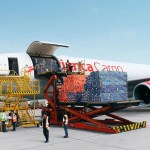
Miami International Airport (MIA) may be best known for passengers, but it is one of the most powerful cargo airports in the world – and 2024 proved it yet again. The airport closed the year with its fifth straight record-breaking year in cargo, handling just over 3 million tons, a performance that propelled MIA to #1 in the U.S. for international freight, #3 in the U.S. for total freight, and #5 globally for international freight.
“Our cargo operation has really exploded,” says Ralph Cutié, MIA’s director and CEO. “We continue to be one of the premier cargo airports in the country and in the world.” As of April 2025, MIA was already tracking 14% ahead of last year’s record cargo volume, defying global trade headwinds and tariff uncertainty.
Few markets depend on perishables the way MIA does, and few serve them better. Roughly 68% of all perishables entering the U.S. flow through MIA, including 91% of the nation’s imported flowers, 65% of fruits and vegetables, and 55% of seafood. Miami’s position as a hub for Latin American agriculture, combined with its unmatched cold chain infrastructure (nearly 500,000 square feet of on airport cold storage) gives it an edge few airports can match.
Perishables aren’t the only story. High-value pharmaceuticals, electronics, and industrial goods continue to move in large volumes through MIA’s air cargo network. About 50% of inbound cargo is transshipped onward by air or truck, giving MIA a central role in U.S. and hemispheric supply chains.
The airport is also investing for the future. A new $140 million phytosanitary and cold chain facility, co-developed with PortMiami and funded in part by a federal grant, will add treatment, fumigation, and expanded cold storage capacity. An 800,000-square-foot Vertically Integrated Cargo Community (VICC) is also underway. Once completed, it will expand MIA’s cargo capacity by 50%, enabling the airport to hit its 2041 cargo volume targets 10 years early.
Cutié also points to MIA’s expanding air network. The airport is in advanced talks with five Middle Eastern carriers, several Eastern European airlines, and Japan Airlines, while a new direct air cargo route from Guangzhou to MIA launched in June, accelerating cross-border e-commerce. “Our goal is to continue growing, and to stay on top,” says Cutié.
PORTMIAMI
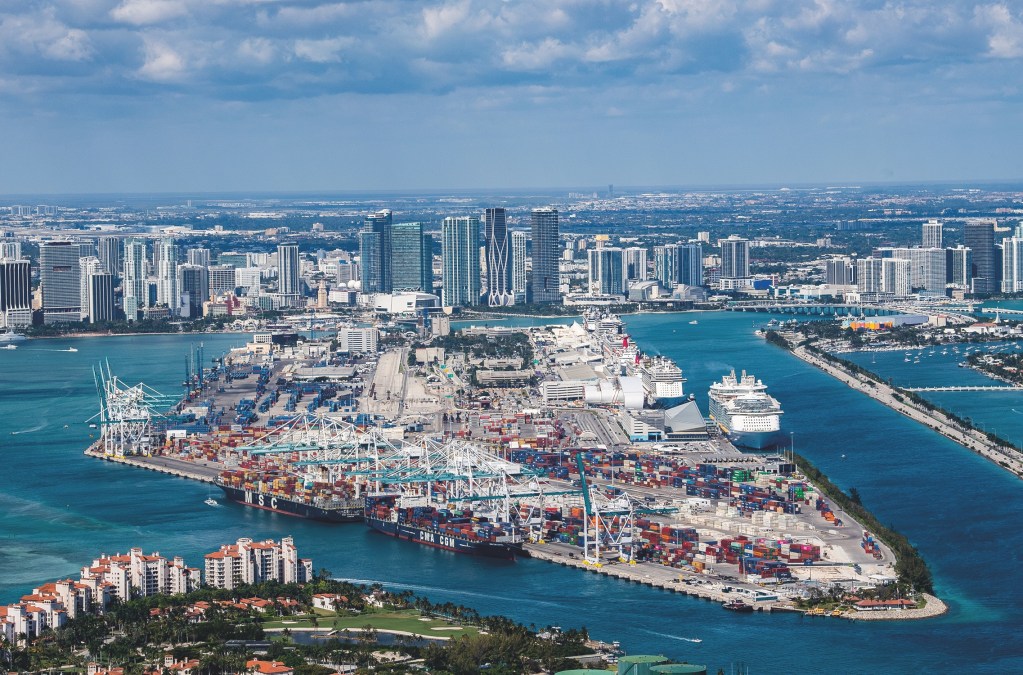
In 2024, PortMiami strengthened its role as one of the most diversified ports in the U.S. – and as one of the region’s most forward-looking. “We were flat in 2024 cargo volumes, which was a win in this environment,” says Director and CEO Hydi Webb. That stability was no accident. The port’s highly diversified trade mix – roughly 46% Latin America and Caribbean, 33% Asia, and 20% Europe and the Mediterranean – continues to insulate it from major trade shocks.
As of mid-2025, PortMiami’s cargo volumes were up 3% year-over-year, outpacing national trends. The port has consistently handled more than 1 million TEUs annually for the past decade and remains Florida’s #1 container port for international trade and 11th in the U.S.
That resiliency is matched by aggressive infrastructure investments. The port recently launched Phase 2 of its yard densification project, adding 18 new electric rubber-tire gantry cranes to increase container stacking efficiency and handle growing volumes within its limited footprint. Meanwhile, a $70 million federal grant will enable expansion of PortMiami’s on-dock rail system from three to five tracks, allowing faster intermodal connections – with the ability to reach 70% of the U.S. by rail in just four days.

Looking inland, PortMiami is advancing a new inland port project in western Miami-Dade County, in partnership with Florida East Coast Railway. The inland port will give shippers additional options for container staging, customs clearance, and intermodal transfers, freeing up dockside capacity and helping accelerate turn times at the seaport itself.
The port’s deep dredge continues to deliver strategic value. “Without that dredge, over 2,000 vessels we’ve received wouldn’t have been able to call here,” says Webb. PortMiami remains the deepest port on the East Coast south of Virginia, giving it an edge in attracting larger vessels and new services. That includes a notable wave of new routes in the past year: three new services from Asia, four from Europe and the Med, and additional growth in Latin America connections. “Nearshoring is real,” says Webb. “We are seeing more manufacturing in Mexico and Central America, and that is directly benefiting us.”
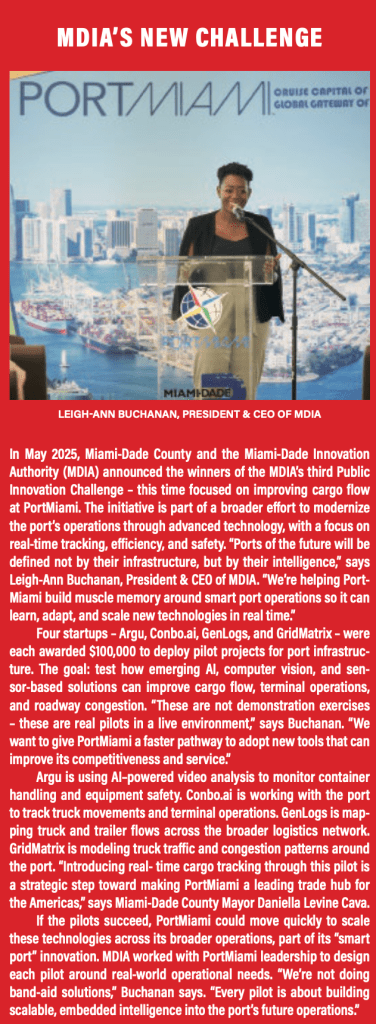
The port is also advancing its push for greater cargo visibility and efficiency. It recently partnered with the Miami-Dade Innovation Authority on an AI-driven initiative to track truck movements and improve traffic flows through the port, a critical move as congestion and speed-to-market become competitive differentiators.
Webb remains optimistic but pragmatic. “We are tracking the tariffs closely. There is a lot of uncertainty,” she says. “But our diversified trade pattern and strong relationships give us confidence that we’ll continue to grow.”
PORT EVERGLADES
At Port Everglades, trade is big business – and growing. The port generated nearly $28.1 billion in economic activity in Fiscal Year 2024, a 6% increase over the prior year, according to a report by Martin Associates. Its cargo and cruise sectors now support more than 204,000 jobs regionally, including 12,270 jobs directly tied to port operations. “The numbers demonstrate that our port’s position as a leading economic engine is well-earned and of great value to Broward County, and Florida’s residents and visitors,” says Joseph Morris, CEO and port director of Port Everglades.
Port Everglades operates as a self-supporting enterprise fund, requiring no local tax dollars for operations or capital improvements, while contributing more than $1.1 billion in state and local taxes annually. That number reflects a port built for efficiency and specialization. Strategically located just two miles from I-95, Port Everglades is one of Florida’s most multimodal seaports, offering seamless integration between ocean, rail, air, and highway networks.
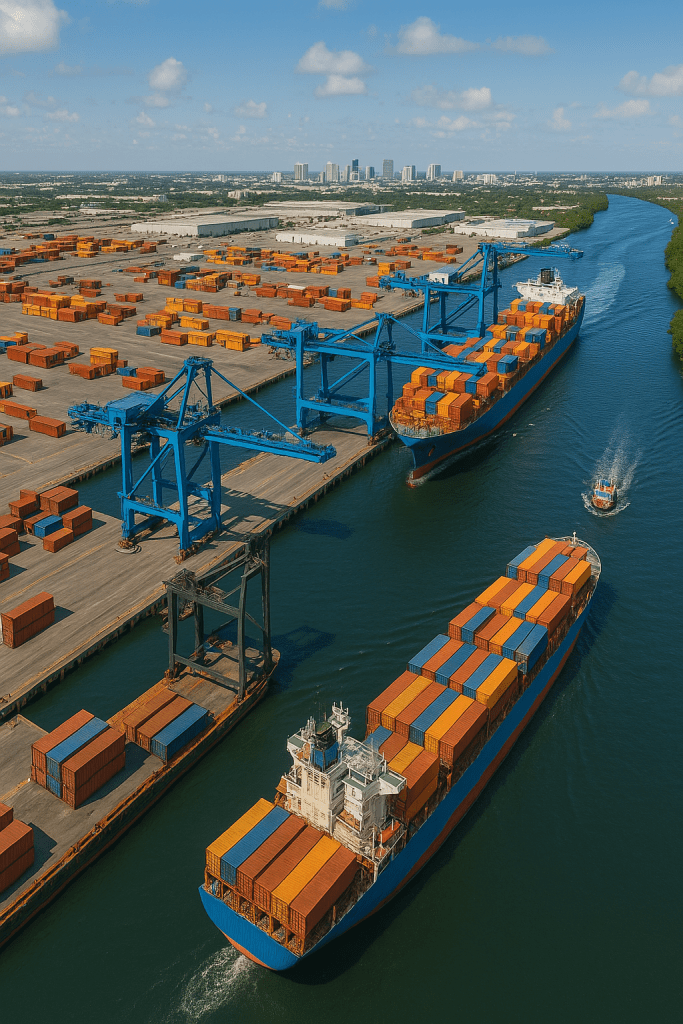
Nearly 90% of Port Everglades’ trade flows through Latin America and the Caribbean, and about 80% of inbound cargo remains within an 80-mile radius, feeding South Florida’s high-consumption market. The port is also a national leader in refrigerated cargo. It ranks as the #1 perishable seaport in Florida and #7 in the U.S. Its advanced cold chain infrastructure handles bananas, avocados, pineapples, seafood, and more, supported by the only on–port Chiquita ripening facility in the U.S. “We handle the product so it’s in prime condition for local retailers the moment it’s needed,” says Jorge Hernandez, Director of Business Development.
The port is equally vital to Florida’s energy supply chain. Port Everglades delivers 100% of the jet fuel used by Fort Lauderdale– Hollywood International and Miami International Airports, as well as all the gasoline and diesel for Broward, Miami–Dade, and Palm Beach counties, making it a 24/7 energy hub for the region.
Operational flexibility is another hallmark. The port maintains a rare trade surplus, with a 52% export / 48% import split, driven by containerized exports and robust roll–on/roll–off trade to Caribbean nations. It also ranks #1 nationally for yacht imports, with growing volumes of luxury yachts transported via semi-submersible vessels.

Infrastructure investments are keeping pace with demand. The recently completed $471 million Southport Turning Notch Expansion added 1,500 linear feet of new berthing and six Super Post–Panamax gantry cranes, enabling the port to handle vessels up to 14,000 TEUs. That has already attracted new Mediterranean services, bringing in high–value cargoes such as ceramic tile, marble, and yachts.
Looking ahead, the port is preparing to launch its long–awaited deepening and widening project, deepening the harbor from 42 to 48 feet and widening key channels to safely accommodate the next generation of large vessels. “It’s a critical project that ensures we can meet future demand and serve larger ships,” Morris says.
Port Everglades is also investing in terminal automation, AI– driven cargo tracking, and advanced terminal operating systems to further accelerate throughput and enhance supply chain visibility. A new 20–year Master Plan is in progress to guide long-term growth. “We have good problems – demand that continues to grow,” Morris says.