Perspectives on the Miami Customs District, today and tomorrow

In a year where global trade reached a record $33 trillion, according to the UN’s latest Global Trade Update, South Florida’s trade engines – its ports, its airports, its people – once again demonstrated their ability to adapt and thrive amid persistent economic and geopolitical uncertainty.
The outlook for 2025 is already clouded by escalating tariff threats, shifting U.S. policy signals, and global supply chain recalibrations. And while global trade reached a record in 2024, the growth was driven largely by a 7% surge in services trade – with goods trade remaining uneven, growing just 2% and still below its 2022 peak. In contrast, the Miami Customs District – Miami-Dade, Broward and Palm Beach counties – surged to $144 billion, up 5% from the prior year.

Of the $144 billion in total trade for 2024 (up from $137 billion the prior year) exports totaled $78 billion, while imports rose to $66 billion. “From our vantage point, the Miami market continues to present unique opportunities – even amid uncertainty,” says Lenny Feldman, managing partner for international trade law firm Sandler, Travis & Rosenberg. He points to Miami’s deep integration with the Americas as a key advantage, noting that in an era of decoupling from China, companies are increasingly looking south for new sourcing and manufacturing partnerships.
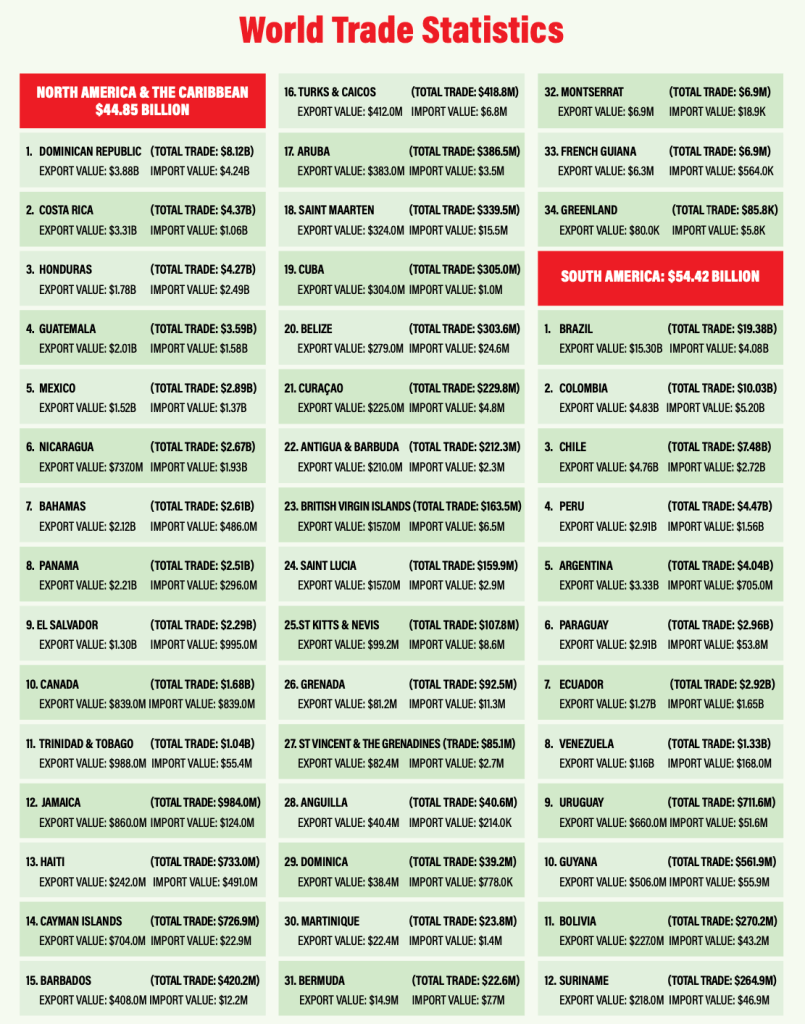
That regional strength is evident in the district’s trading relationships. Brazil remained the district’s top trading partner, with $19.38 billion in total trade, propelled by a commanding $15.3 billion in exports from Miami. Colombia followed at $10.03 billion in total trade, with the Dominican Republic, China, and Chile rounding out the top five.
Aircraft parts led the charge among exports, reaching $11 billion – part of a broader surge in high-value aviation, technology, and medical goods that now define Miami’s export profile. Telephones followed at $6.06 billion, buoyed by strong demand across Latin America. Computers, packaged medications, vaccines, integrated circuits, and medical instruments all saw robust movement through the district as well, underscoring Miami’s role as a conduit for both innovative products and essential goods.
Imports, meanwhile, reflect a supply chain landscape in flux. While China remains the largest source of goods, import volumes from Southeast Asia and Latin America continued to rise in 2024. Ancona describes this as part of a long-arc regionalization trend – one accelerated by both COVID-era supply shocks and preparation for the 2024 U.S. presidential elections. “We started seeing that shift into the first quarter of 2025,” she says. “That’s where the data goes a little wonky.”

Telephones remained among the district’s top imports at $4.23 billion, but sourcing shifted. Vietnam, Malaysia, and India all gained share, reflecting supply chain recalibrations away from China. “China’s been on the decline for a bit,” Ancona says. “It’s just because it’s been shifting to other parts of Asia. Everyone is trying to regionalize.”
Other import categories mirrored the complexity of this transition. Gold shipments surged to $3.73 billion, underscoring Miami’s status as a financial gateway. Fish fillets ($2.38B), largely from Chile and other South American partners, highlighted the district’s ongoing strength in perishables handling. Cut flowers ($1.88B) remained a Miami staple, and recreational boats ($1.65 billion) reflected the continued demand from South Florida’s high-end leisure sector.
Beyond individual product categories, the real story of 2024 was one of structural change. As Feldman explains, “People are now looking south of Miami.”The importance of Miami’s re-export capabilities should also not be underestimated. Roughly half of U.S. imports are not destined for domestic consumption but instead serve as inputs for manufacturing or re-export. Miami, with its deep expertise in transshipment, is positioned to support that flow. “It’s why you see such a diversity of product categories here,” he says. “From perishables to apparel to aircraft parts – it all moves through Miami because we know how to handle it.”
WHAT PORT HANDLES WHAT: NUMBERS AND NICHES
No single port defines the Miami Customs District trade story. Rather, it is the complementary roles of PortMiami, Port Everglades, and Miami International Airport that allow the region to serve as one of the world’s most versatile trade hubs.
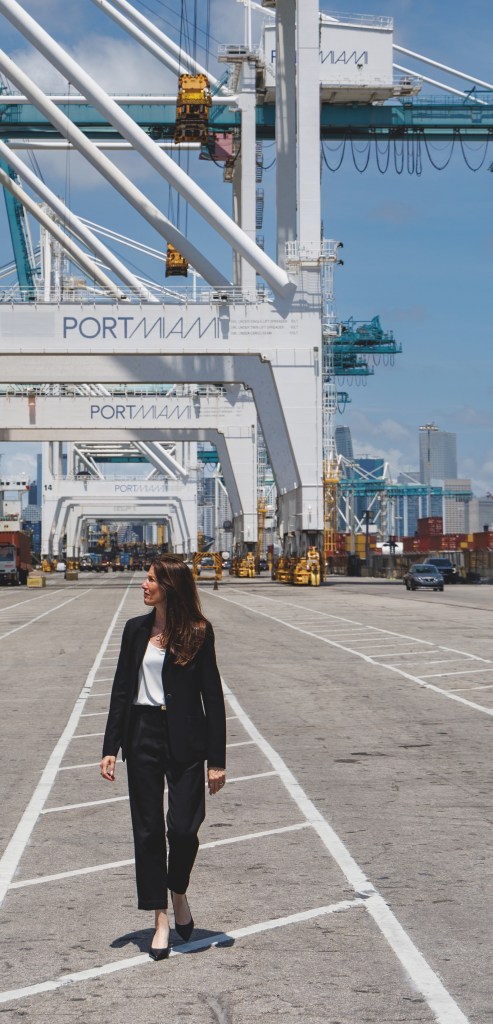
PortMiami remains Florida’s leading container port for international trade and the 11th largest in the U.S. In 2024, the port’s trade totaled $30.4 billion and processed just over 1 million TEU containers – marking a 3% year-over-year gain in a global shipping environment where many ports saw declines. “Our diversified trade pattern is our strength,” says Hydi Webb, PortMiami director and CEO. The port’s cargo mix breaks down to roughly 46% Latin American and Caribbean, 33% Asian, and 20% European and the Mediterranean. Perishables, textiles, and apparel continue to anchor the North-South trade, while electronics from Asia and construction materials and furnishings from Europe moor East-West trade.
Port Everglades plays an equally vital role – particularly in serving Florida’s fast-growing consumer market. With trade totaling $27.9 billion, nearly 90% of Port Everglades’ commerce is with Latin America and the Caribbean, and about 80% of inbound cargo remains within an 80-mile radius of the port. “We’re the number one perishable [sea] port in Florida and seventh in the U.S.,” says Joseph Morris, CEO and port director at Port Everglades. The port’s big three sectors – containerized cargo, energy, and cruise– each posted near-record results in fiscal 2024. In the container space, top imports include bananas, fish, semiconductors, beer, and apparel; ceramic tile, marble, and high-value yachts (in break bulk) from Europe. The port also stands out for its export strength, maintaining a rare trade surplus with a 52%/48% export-import split.

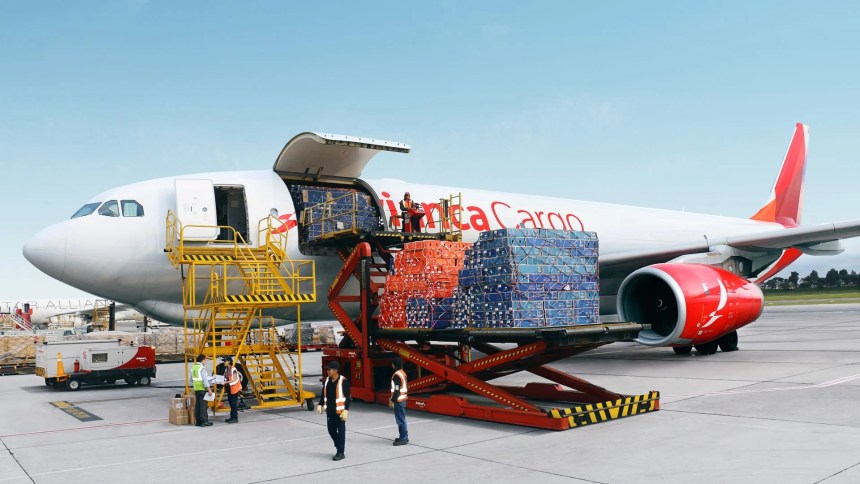
Miami International Airport rounds out the triad with dominance in total trade by value, at $82.33 billion. MIA recorded its fifth straight record-breaking year in 2024, handling more than 3 million tons of cargo. The airport remains the No. 1 U.S. airport for international freight and ranks fifth globally. “We basically own the perishables market,” MIA CEO and Director Ralph Cutié says. Nearly 70% of all U.S. perishables imports – led by flowers, fruit, and seafood – move through MIA. The airport’s deep cold chain capabilities and fast air connectivity make it indispensable for time-sensitive, high-value goods. Electronics, pharmaceuticals, and industrial equipment also flow steadily through MIA’s expanding cargo network. As of early 2025, the airport is tracking an astonishing 14% year-over-year increase in cargo tonnage – underscoring its continuing importance to Miami’s trade ecosystem.
THE SERVICES SECTOR: MIAMI’S HIDDEN TRADE GIANT
When people talk about Miami’s role in global trade, they typically speak of ships and planes, ports and warehouses. But in truth, some of Miami’s most important exports don’t move through cargo holds. They move across networks, in legal briefs, through financial transactions, and inside the ideas and expertise of its people. Services, long an underestimated force in Miami’s trade profile, are in fact the U.S. ‘s leading export – and in Miami’s case, an essential and fast-growing part of the region’s global economic footprint.
“We trade ideas and expertise as much as we trade goods,” says Ancona. “You may not see that in the same way you see a cargo plane landing or a ship docking, but it is every bit as significant. In fact, in many ways, it’s what makes the physical trade possible.”
It’s a reality that’s easy to overlook in a district known for its towering container volumes and dominant perishables market. Yet services account for roughly one-third of the Miami metropolitan area’s exports – a share that has steadily increased over the past decade. In 2024, U.S. services exports reached a record $1.1 trillion, led by sectors like finance, legal, consulting, education, and technology. In Miami, that invisible flow is everywhere.
South Florida has evolved into a hemispheric headquarters city, a place where businesses of every scale – from startups to multinationals – manage cross-border operations. Many of these firms trade in services first and foremost. Downtown Miami hosts one of the largest concentrations of international banks in the country, with institutions that annually facilitate billions of dollars in trade finance, cross-border lending, and currency transactions. Law firms advise clients on free trade agreements, tariff engineering, and complex international regulations. Marketing and media companies export creative strategies to markets across Latin America. And Miami’s fast-growing fintech, healthtech, and digital commerce sectors are expanding their international reach. “Our trade system wasn’t really designed for this level of digital integration,” Ancona explains. “But that’s where the world is headed. And Miami is right in the middle of it.

”From his vantage point at Sandler, Travis & Rosenberg, Feldman perceives the same shift. “We see an incredibly diverse portfolio of companies coming to us for guidance,” he says. “It’s not just about how to move products anymore. It’s about how to structure deals, how to navigate services trade rules, how to support clients across multiple markets.”
The district’s cultural fluency also gives it an edge. With a multilingual workforce and deep connections to Latin America, Miami offers companies an unrivaled gateway for both goods and services trade in the Americas. Many regional headquarters for Latin America operations are based here precisely for that reason. “We’ve built up an ecosystem here that’s second to none,” Ancona says. “And in an uncertain world, that kind of intellectual capital is invaluable.”
NAVIGATING THE CURRENT POLITICAL CLIMATE: TRADE STRATEGIES SHAPING MIAMI’S FUTURE
In late 2024, as the U.S. presidential election cycle unfolded, companies across South Florida began racing against the clock. The threat of new tariffs – widely expected and soon realized – triggered a wave of front-loading across the Miami Customs District.
“Once the election happened, everyone knew this is going to be a tariff moment,” recalls Ancona. By early 2025, many importers had already adjusted their strategies, moving shipments forward and holding inventory in anticipation of an unsettling year. The move was not without precedent. “It’s kind of like COVID part two – without the pandemic,” Ancona says. “It’s a continuous shift toward more regionalization, and companies are adapting again.”
The current moment reflects a broader truth about global trade, that it is an organism, constantly responding to its environment. Tariff threats and political uncertainty have accelerated the shift from just-in-time to just-in-case logistics, driving new behaviors as companies rethink fundamental aspects of their supply chains.

It is a shift that plays to Miami’s natural strengths, with its deep connectivity to the Americas, its air and sea links, and its regional expertise. All make it an ideal place for companies seeking more predictable, tariff-resilient pathways. “We’re seeing a real opportunity now,” says Feldman. “A lot of importers and exporters are looking to divest from China – not just to Southeast Asia, but to Mexico, Central America, South America, and the Caribbean.”
Mexico, in particular, is poised to play an outsized role in this evolving landscape. “When tariffs were announced, we weren’t [significantly] affected,” Mexican Ambassador to the U.S. Esteban Moctezuma Barragán told Global Miami. “A car built in Mexico might contain 40 to 70 percent American components. That part cannot be subject to a tariff. So, if a 25 percent tariff is imposed and your content is 50 percent American, it effectively drops to 12.5 percent. We’re working to clarify that. But what’s most important is how we approach the USMCA review. That will define the future of the bilateral – and the North American – relationship. We are the most competitive region in the world, and we share similar values.”

That regional competitiveness is fueling new trade corridors. “Our relationship with Florida has been growing,” Ambassador Moctezuma said. “Florida has important comparative advantages due to its location. As Mexico develops the interoceanic corridor, the state that will benefit most is Florida – because of its position and because of the new economic trends that will emerge.”
Even for companies that cannot easily shift supply chains, Miami offers tools to weather the current volatility. “A lot of companies [will] use first sale, duty drawback, and the Foreign Trade Zones,” says Ancona. “They just didn’t use them before because trade was good.” Now, she says, it’s about cost survival: “They’re asking, ‘What tools are available to me right now to make those cost-saving decisions?’”
She explains: “First sale is a way of pricing how goods get tariffed – it’s complicated, and it requires using professionals to help navigate that. Duty drawbacks are like getting a refund. A lot of companies never pursued those refunds, because it felt like extra work. Now they are going back to talk to the professionals to get the duty drawback, or adjust the first sale valuation, or finally activate an FTZ because they can save on the tariff.”
PortMiami Director Hydi Webb notes: “Right now, I think we have over 100 active Foreign Trade Zones. Some of these zones are seeing an influx of cargo to hold while the tariff situation works out.” Gary Goldfarb, chief strategy officer for Interport Logistics, and chair of the World Trade Center Miami, has seen demand explode. “I’ve been doing tens of Foreign Trade Zones every week,” he says. “I think I’m now close to 900 FTZ activations either done or in process.” For companies using FTZs correctly, the benefits are clear: “You can receive products, not pay duties while they’re in the FTZ, and only pay duties if they enter U.S. commerce. If you export, you never pay the duty.”
This resurgence of interest in trade tools also reflects a structural shift. “Tariffs are really a return to businesses requiring professionals to help them move their merchandise,” Goldfarb explains. “It’s not as simple as it used to be. Now you need compliance experts, and tools like FTZs are at the forefront.”
The broader reality is that uncertainty will continue, and trade volatility will be passed through the entire economy. “We’re paying for it,” says Ancona. “Walmart’s going to have to raise prices, and other retailers will follow. The consumer is going to feel it.”
In that environment, South Florida’s logistics and compliance ecosystem will matter more than ever. As Goldfarb puts it: “Our community of somewhere around 1,900 [commercial and professional] entities is probably the most experienced, most knowledge-based anywhere in the country – potentially anywhere in the world.”
2025 OUTLOOK
As Miami Customs District enters 2025, trade leaders across the district are bracing for a year where political risk, evolving trade policies, and shifting consumer demand will require constant adjustment, not static strategy. The United Nations Center for Trade and Development [UNCTAD] outlook highlights key risks: escalating trade wars, potential U.S. policy shifts, and ripple effects across supply chains. “You can’t look at the trade data by itself,” Ancona says. “Consumer confidence, employment trends, and political decisions are now direct drivers of what moves through Miami.”
Companies will likely continue pursuing regionalization and supply chain agility – but with greater urgency. The Miami market is already seeing an uptick in Mexican and Latin American trade volumes, and new East-West air cargo links are building a more diversified network. A new Guangzhou-Miami route, for example, coupled with pending talks for Middle Eastern and Eastern European service, points to Miami’s growing role as a global transshipment and e-commerce center.
At the same time, services trade will continue to act as a stabilizer in an otherwise volatile goods environment. Certainly risks remain. U.S. tariff policy under the new administration could trigger rapid shifts in sourcing patterns and consumer prices. Retailers are already signaling potential price increases, which may dampen discretionary demand – a critical issue for Miami, given its exposure to tourism, luxury goods, and consumer-driven trade.
2025 will likely be a year of fragmented but high-value opportunities, where agility will trump volume. Companies that can move fast, hedge risk, and tap Miami’s deep multi-modal and services ecosystem will gain an edge. As MIA’s Ralph Cutié put it: “Miami always adapts.”


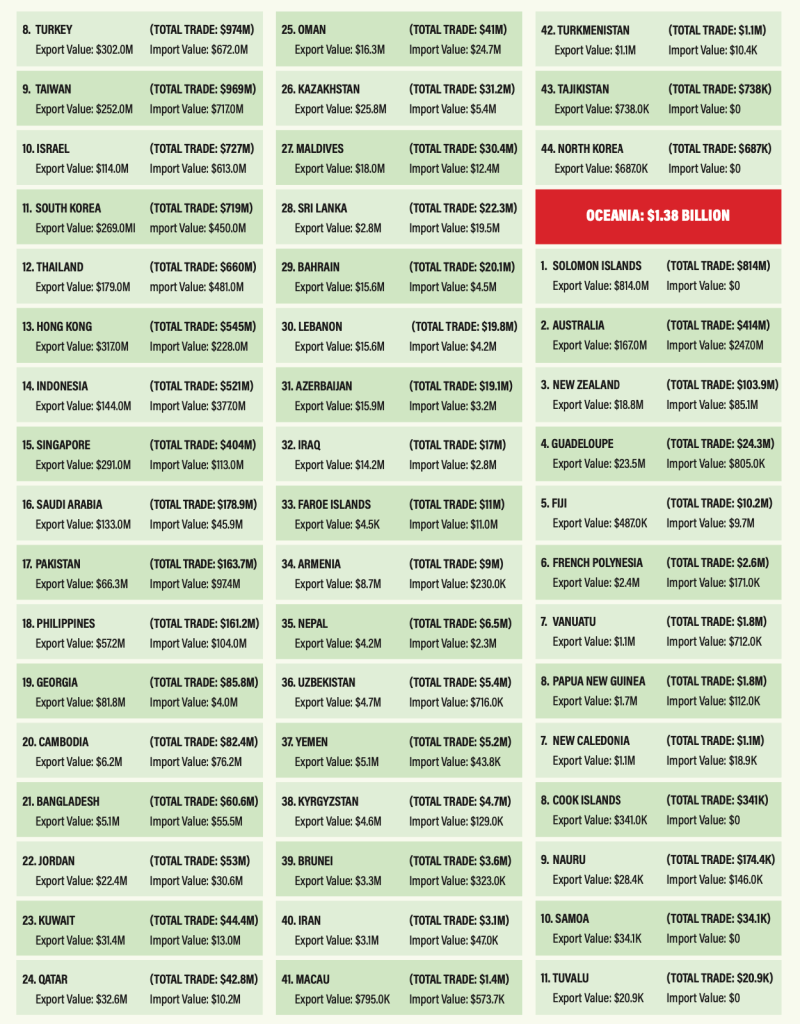
Top 10 Miami Customs District Trading Partners 2024
The Americas advantage: Miami’s Invaluable Trade Position
Even though Canada and Mexico are the top trading partners of the U.S., their combined trade with the Miami Customs District (Miami-Dade, Broward, and Palm Beach counties) – even with Central America and the Caribbean included – still falls $10 billion short of the trade with South America. Of the top 10 trading partners, the four from South America amount to $40 billion in trade, twice the four from Central America and the Caribbean, and more than five times the trade with China.
With strong trade ties with South America, Central America and the Caribbean, Miami is well positioned to survive the current turbulence in tariffs, since these areas are facing far lower increases than Asia or Europe. While particular commodities and products – such as steel and building supplies – face high tariffs regardless of origin, as a region the Americas (excluding Mexico and Canada) are facing the less stringent trade winds of 10% tariffs. The rest of the world faces far higher jumps.
In the general de-coupling from China and other Asian sources of production, the Americas offer an attractive alternative for offshoring of low-cost manufacturing. Already, Central American nations such as El Salvador and Guatemala are seeing new factories geared in particular to the production of clothing; in the Caribbean, the Dominican Republic is making a concerted push to become a manufacturing center.
For offshore production as well as for perishable imports, the shorter shipping distances to the Americas (versus Asia or Europe) further reduce costs, and result in shorter lead times for “just-in-time” manufacturing. Miami also enjoys a pivotal position as a distribution hub for the Americas, where, for example, European goods can be transshipped from Free Zone warehouses in Miami for distribution points across the hemisphere.
And, as far as balance of trade goes, Miami holds the advantage, at least amount its top 10 trading partners, with $42 billion in exports versus $30 billion in imports. And this does not include the city’s vast surplus in service exports, in everything from professional talent to entertainment and tourism.