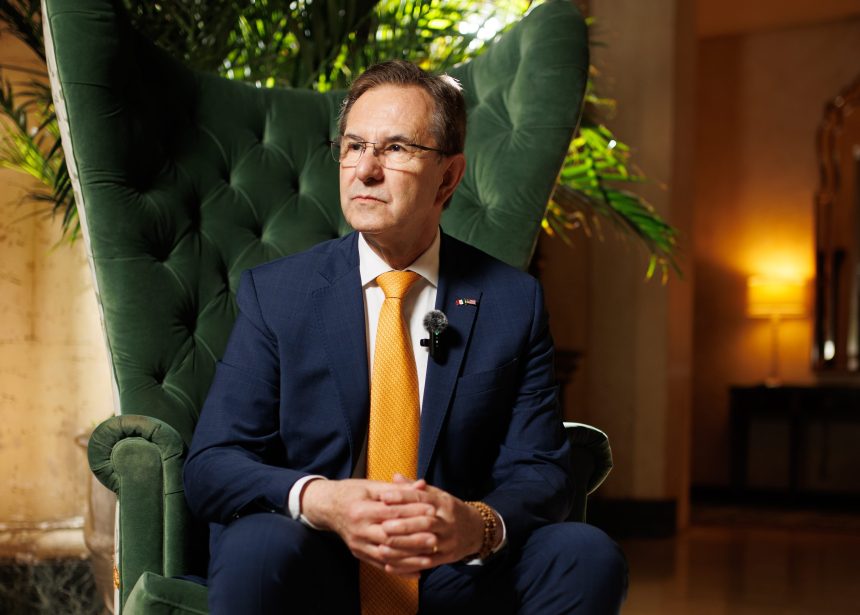
During a recent visit to Miami hosted by the World Affairs Council Miami as part of their Mark Samuelian Distinguished Speaker Series, the Ambassador of Mexico to the United States sat down with Global Miami Magazine to discuss the economic and cultural ties between Mexico and Florida. With trade tensions rising, nearshoring becoming the new norm, and an increasingly integrated North American region, the Ambassador sees a future built on collaboration and shared prosperity.
What defines the connection between Mexico and Florida today?
We have a vibrant relationship. Mexico is Florida’s number one trading partner. We exchange nearly $15 billion each year, and that trade generates around 310,000 jobs. It’s a very positive relationship – and one that will continue to grow beautifully.
What are your impressions of Miami?
I was really looking forward to visiting Miami. Of our 53 consulates in the U.S., Miami is very important – not just because of the Florida-Mexico relationship, but because Miami and Florida represent the Americas in a nutshell. This is a multicultural, sectoral society that knows how to share, how to live together, and how to progress. Florida has grown significantly in recent years and has an innovative approach to development. That’s one of the reasons I’m so thrilled to be here.
What kind of economic opportunities do you see between Mexico and Miami?
Ports of entry are developing quickly. We just finished Otay Mesa II in California and are starting a huge new port of entry in Laredo, Texas. But seaports are also critical – they must reflect the importance of trade. Mexico just developed an interoceanic train connecting the Gulf of Mexico and the Pacific. It would be very important to develop a route through Florida to reach the western U.S. Imagine the opportunities for Florida businesses once they realize they can reach the West Coast through the Isthmus of Tehuantepec in Mexico.
Could Florida become as important to Mexico as Texas and California?
I think our relationship with Florida has been growing. Florida has important comparative advantages due to its location. As the center of Mexico develops through this interoceanic corridor, the state that will benefit most is Florida – because of its position and because of the new economic trends that will emerge. I believe Florida has a lot to offer not just to the U.S., but to North America as a whole.
How is Mexico preparing for potential U.S. trade policy changes, especially tariffs?
Mexico has benefited from the USMCA. When tariffs were announced, we weren’t affected – zero tariffs were applied to Mexico. We’re also working closely with the automotive industry. A car built in Mexico might contain 40 to 70 percent American components. That part cannot be subject to a tariff. So if a 25 percent tariff is imposed and your content is 50 percent American, it effectively drops to 12.5 percent. We’re working to clarify that. But what’s most important is how we approach the USMCA review. That will define the future of the bilateral – and the North American – relationship. If you look at geopolitics, and if the U.S. wants to remain competitive globally, then North America – Mexico, the U.S., and Canada – must work as one. We are the most competitive region, and we share similar values.
Is Mexico working with Canada on these negotiations?
Yes, we always work trilaterally. Every time there’s a negotiation, we ask Canada to be part of the table.
Nearshoring has brought new investment to Mexico. How is that affecting trade with Florida?
Trade has been growing in recent months, and nearshoring is helping strengthen that relationship. We are producing components for semiconductors, AI, the automotive sector, aerospace – many sectors. Mexico is part of that supply chain. Our supply chains are resilient, and that makes both countries more competitive.
What advice would you give to Mexican and South Florida businesses navigating today’s global economy?
Be innovative. The whole structure of international trade is changing – and so is the economy. We had the Industrial Revolution, then the digital one, and now we’re entering the AI revolution. We must prepare for the new jobs and new demands this will bring. The relationship between Mexico and Florida in these advanced sectors will be key. My advice is: bet on certainty. Mexico offers certainty – we have the USMCA, we have political and social stability. If you look at President Claudia Sheinbaum’s approval numbers, they’re among the highest in the world – 83 percent. Mexico is stable, and our commitment to the U.S. is long-term. We’re not looking for short-term gains – we’re betting on the long term. We’ve had diplomatic relations for 202 years, and we’re betting on another 20 years just as productive.
There’s also been a wave of Americans – digital nomads – moving to Mexico. What are your thoughts on that?
Yes, especially in Mexico City. If you go to neighborhoods like Roma, Polanco, or Condesa, the language you hear is English. It’s not just Mexico City either. I was recently at the San Ysidro port of entry on the U.S. side, looking at the lines of cars entering the U.S. – and a CBP agent told me, “Those are all Americans living in Mexico.” The border region is very vibrant – 35 million people live there and take advantage of both sides. They work in one country, sleep in another, go to the doctor in one place and school in another. When more Americans realize that, they’ll see how close Mexico and the U.S. truly are – not just in trade, but culturally.
What can we expect from the future of Mexico–Florida relations, especially with the Mexican community here?
I think we’re not always aware of how intertwined our cultures already are. Most Americans have a relationship with Mexico – they just don’t know it. The fruits and vegetables they eat in winter, the car they drive, the TV they watch – many of those come from Mexico. Even the evolution of American taste reflects Mexican influence. Once we resolve the irritants in our relationship, people will realize how close and important Mexico is. We are part of the solution. On migration, for example – most people crossing through Mexico aren’t even Mexican. But Mexico is the one managing that flow. We’re helping the U.S. in a big way. There are many examples like this, and once they become clearer, people will see how essential this relationship is to raising the standard of living in both countries.