Nonstop movement by land, air, and sea
At sunrise on a spring morning at Port Everglades, dozens of logistics executives, freight forwarders, legal advisors, and port officials filed into the Celebrity Cruises terminal for a summit that felt less like a meeting and more like a mission. The message: South Florida isn’t just a trade gateway. It’s the control center of the Western Hemisphere’s logistics network — and Greater Miami is redefining what that means in an era of nearshoring, e-commerce, climate challenges, and tumultuous tariffs.
“This is exactly what we need,” said Vice President of the United States-Mexico Chamber of Commerce Diego Morones. “We’re in a moment of global chaos, but also opportunity. We need spaces to reassess and have real conversations about what the future holds.” The future, as it turns out, is already arriving in South Florida.
SOUTH FLORIDA, A LOGISTICS LEADER
South Florida’s rise as a logistics powerhouse didn’t happen overnight. It’s the result of decades of planning, investment, and a drive to stay one step ahead of global trade trends. From the days of container ships arriving with textiles and fruit to today’s interconnected network of ports, rail lines, air cargo hubs, and digitally optimized warehouses, the region has transformed itself into the linchpin of commerce between the Americas – and increasingly, the world.
“South Florida is critical for exports to the Caribbean and Central America, especially for perishables,” says the first vice president of the Florida Customs Brokers and Forwarders Association (FCBF) and president of Cargo International Consolidators, Michelle Fajardo. “A lot of my clients buy their produce here because we’re a major importer and re-exporter. There’s a whole fast-turnover economy that relies on South Florida’s logistics.”

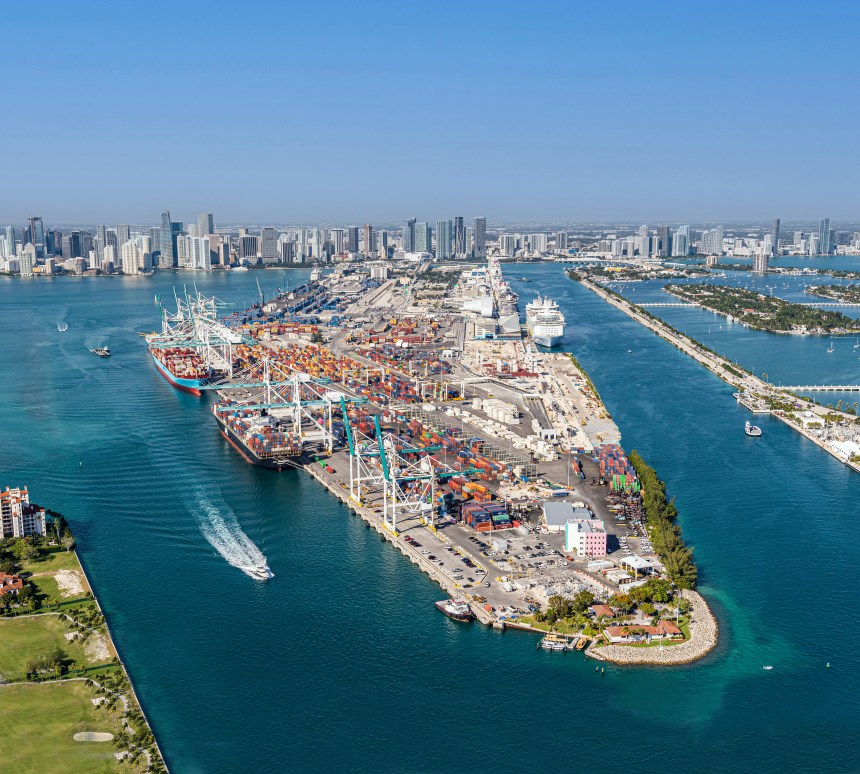
At the heart of this dynamism are the region’s three logistics pillars: PortMiami, Port Everglades, and Miami International Airport. Together, these hubs handle hundreds of billions in trade annually, fueling everything from fast fashion to pharmaceuticals. Yet it’s not just the volume that’s impressive – it’s the intelligence of the system. Data integration, trade expertise, and policy agility allow South Florida to serve not only as a conduit for goods, but as a decision-making core for global supply chains.
Infrastructure is the skeleton of any logistics operation. The expansion of Port Everglades is one of the most visible signs of this evolution. With its $471 million Southport Turning Notch Extension, the port adds 1,500 feet of berth space and features Super Post-Panamax cranes that can handle the larger vessels. The project is part of a master vision plan that spans decades and includes not only physical upgrades, but also deeper community partnerships and environmental mitigations.
PortMiami, for its part, has recently seen new shipping services that are making it a first-in call from both South America and Europe – a strategic advantage that reduces delays and ensures cargo gets to inland destinations faster. “We started new services from the east and west coasts of South America, and a few from Europe. It’s the first time in over a decade that we’re seeing Miami as the first port of call from these regions,” says PortMiami director Hydi Webb.

Those first-in calls matter. They reduce dwell times, improve container velocity, and attract more shippers looking for quicker service to inland markets. PortMiami’s intermodal rail and its downtown tunnel – diverting 80% of container truck traffic – are key assets. The expansion from three to five rail tracks will allow for more frequent and larger train volumes, improving connectivity to distribution centers across the state and beyond.
“Miami-Dade County is one of the top trading destinations of the Americas, thanks to the world-class infrastructure and operations that run our record-breaking airport and seaport every day. PortMiami has not only transformed our iconic skyline and bolstered our economy, but its ongoing commitment to bringing innovation and technology will allow the seaport to work more efficiently, create local jobs, and serve our global customers better,” says Miami-Dade County Mayor Daniella Levine Cava.
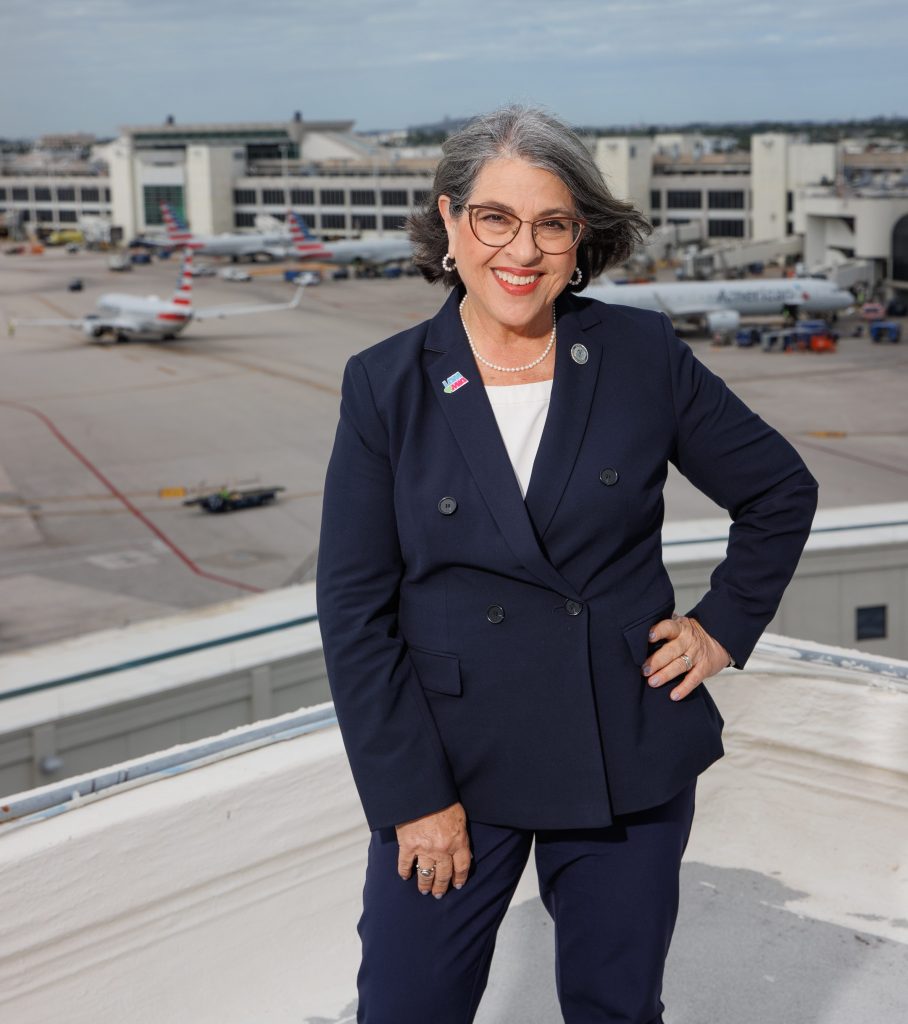
Miami International Airport (MIA) is also moving mountains – by air. Ranked the number one U.S. airport for international air freight, MIA processes goods from perishables to electronics with growing speed and efficiency. The airport is developing a Vertically Integrated Cargo Community (VICC), a new facility that will expand capacity by 50% and include multi-level warehousing, sustainable design, and space for e-commerce operators.
“It will be more integrated and efficient than existing facilities at MIA and is designed to be completely sustainable,” said MIA Director and CEO Ralph Cutié. “Until this facility is built, MIA is working towards providing its airport partners with access to a cargo community system (CCS), an app-based technology for streamlining the movement of cargo by connecting the different players in the supply chain on a single platform. The CCS will provide MIA tenants with greater speed, efficiency, and transparency in the movement of cargo, and MIA will gain efficiencies in its overall cargo operations.”
The numbers speak volumes. De minimis shipments – those valued under $800, largely driven by e-commerce – rose from 1.6 million in 2021 to a staggering 75 million in 2023. That’s a 4,587% increase in two years. “What makes the process of moving goods at MIA unique compared to peer airports is the exceptional infrastructure it has in place – both in its facilities and its human resources – for maximizing throughput and efficiency,” says Cutié.

This momentum has drawn global names. UPS operates an international gateway out of MIA, handling thousands of shipments daily for destinations across Latin America.
“After five consecutive years of record-breaking cargo growth, MIA continues taking care of business as they move up the ranks among cargo hubs in the U.S. and the world,” said Miami-Dade County Mayor Daniella Levine Cava. “With the construction of a new cutting-edge cargo facility in the works, the future looks brighter than ever for MIA as a global leader in air cargo. This project is also expected to generate thousands of jobs for our residents and bring new business opportunities to small companies in the construction and cargo logistics.”
A SPRINT TO KEEP UP, SOUTH FLORIDA’S GROWTH
South Florida’s warehouse developers are racing to keep up. Prologis, which owns more than 20 million square feet of logistics space in South Florida, has been at the forefront of smart warehouse development, deploying buildings equipped with robotics, cold storage, solar energy systems, and EV-charging docks. The sites are strategically located near Miami International Airport and the Palmetto Expressway, providing quick access for both imports and exports. In Doral, Bridge Industrial is converting former rail yards into high-tech facilities designed for faster turnaround times and cross-docking.
Cold chain logistics is one of the fastest-growing sectors, stirred by demand for fresh produce, pharmaceuticals, and temperature-sensitive goods. Lineage Logistics and Americold have significantly expanded their refrigerated storage footprints in South Florida, positioning themselves to serve both domestic and export markets.
Companies like Ryder System, headquartered in Miami, manage complex supply chain operations across the Americas. Their integrated services – from fleet management to contract logistics – make them a vital link in industries like retail, auto, and healthcare.
Ryder’s regional footprint includes major distribution hubs in Medley and Hialeah, locations selected for their multimodal access and proximity to key markets. These centers manage everything from temperature-controlled pharmaceuticals to seasonal retail inventories. Ryder’s investment in digital platforms also allows clients to track shipments in real time, making their operations more responsive to market volatility.
FedEx and UPS both operate expansive logistics campuses in the region, tied closely to MIA’s air cargo network. UPS’s international gateway facility at MIA handles thousands of express shipments daily, serving as a hub for Latin American deliveries. FedEx recently opened a new regional sorting facility in southwest Miami-Dade to speed up overnight deliveries across the Southeast.
Amazon, too, has delivery stations scattered throughout the tri-county area and a fulfillment center in Opa-locka. The company’s presence is reshaping last-mile logistics. These facilities support Miami’s role as a two-day shipping center for most of Latin America and a one-day service point for much of the U.S. Southeast.
But infrastructure alone doesn’t move goods — people do. And South Florida’s workforce is increasingly seen as one of its most strategic assets. Gary Goldfarb, Chief Strategy Officer at Interport Logistics and Chair of the World Trade Center Miami, has been sounding the alarm about the need for continued investment in education and talent development.

“This region has knowledge that can’t be taught in a textbook,” said Goldfarb. “We’ve got people who understand the regulatory environment in Brazil, the freight quirks of Panama, the political climate in the Dominican Republic. That kind of insight is priceless.”
Florida International University (FIU) and Miami Dade College are trying to ensure that this expertise doesn’t retire with the most seasoned generation. Dr. Gregory Maloney, who leads FIU’s logistics master’s program, emphasizes real-world learning and systems thinking. “They were hiring a lot of engineering and tech-oriented people at first. But over time, they started to realize that these logistics businesses – at their core – are businesses. Their strength lies in increasing margins and lowering costs, and that’s a business function. That’s not necessarily how an engineer is trained to think,” he explained, “so when we were talking with them, they came to us and said, ‘Hey, these businesses are booming. We need people who understand how business works – how to run operations, how to manage customers.’ That’s what led us to develop the program within the College of Business. Our students graduate understanding the key logistics components, but they are also grounded in business management concepts.”
The result is a talent pipeline that feeds seamlessly into local employers. Amazon, FedEx, UPS, DHL, and third-party logistics firms routinely recruit from FIU and MDC. These graduates are becoming systems analysts, operations planners, and compliance officers. “That speaks to the current state of the industry. We’re evolving – from a landscape filled with smaller, less complex transportation businesses to much more sophisticated operations that function more like large corporations,” says Dr. Maloney.

South Florida’s customs and compliance community is another pillar of its ecosystem. Deborah Stern, a trade attorney at Sandler, Travis & Rosenberg, helps clients navigate what she calls the “regulatory alphabet soup” of agencies – CBP, FDA, DOT, USDA. With the Trump administration’s sweeping 10% tariff reimposition on most imports, her phone has been ringing nonstop.
“Companies are trying to respond to daily changes in trade rules,” Stern said. “They’re reclassifying goods, re-sourcing suppliers, and recalculating pricing models. It’s chaotic, but if you’re compliant, you can be agile. That’s where Miami shines.”
The region’s Foreign Trade Zones (FTZs) are another arrow in the quiver. These federally designated zones allow companies to defer or reduce duties and simplify customs processes. Goldfarb has helped activate more than 900 FTZs in his career. “When trade gets turbulent,” he said, “FTZs are great.”
Nearshoring – the shift of production closer to consumer markets – is also reshaping supply routes. Miami and Port Everglades are both seeing increased traffic from Mexico, Guatemala, El Salvador, and Colombia. Apparel, processed foods, and pharmaceuticals are increasingly sourced from the Western Hemisphere, reducing shipping times and improving resilience.
For perishables and fast-turnover goods, South Florida remains essential. “You can get goods from Miami to Santo Domingo or Nassau in under a week,” Fajardo said. “That time advantage is something you just can’t replicate from farther north.”
Miami’s trade diplomacy is also a growing force. The Beacon Council, Greater Miami Chamber of Commerce, and World Trade Center Miami regularly host delegations from Europe, Latin America, and Asia. These visits generate partnerships, secure foreign direct investment, and signal confidence in South Florida’s role as a trade leader. Public-private partnerships have been instrumental in advancing infrastructure, including port dredging, airport cargo modernization, and broadband expansion to support digital logistics platforms.
“We’re not a major manufacturing hub,” Goldfarb said. “But we’re central to movement. The knowledge economy of logistics is growing right here.”