Israel Tech Week Highlights the Miami-Israel Connection
A live band entertaining at breakfast. Gorgeous fresh flowers. Cocktails at a swanky club. Speakers from leading startups and finance groups. When Israel’s largest financial publication Calcalist held its first-ever conference in Miami in November, the organizers went all out, eager to celebrate Israel’s technology ties to Miami.
Cut to one month later: Israel’s English-language newspaper Jerusalem Post held its first Miami event. Then in January, the powerful Israel Advanced Technologies Industries association IATI offered the first mini-version in Miami of its acclaimed MIXiii conference, underscoring how South Florida is becoming a key hub for Israel’s prodigious technology.
Now, with critical mass building, a highly motivated Miami group organized the inaugural Israel Tech Week 2025 in Miami. The seven-day event is expected to drew 2,500 people and included a robust Israeli presence at South Florida’s premier tech conference eMerge Americas. Israel Tech Week features dozens of Israeli founders and funders in healthcare, finance, energy, and hospitality, to name a few key sectors.

“Momentum is really picking up,” says Rakefet Bachur-Phillips, who co-leads the Florida-Israel Business Accelerator (FIBA) started in 2016. The group has helped nearly 40 Israeli companies launch in the state so far, mainly in Greater Miami. “It used to be a challenge to attract Israeli companies to Florida,” she says. “Now, it’s not. Companies are approaching us, whether they’re coming directly from Israel or from other markets in the U.S.”
WHY ISRAEL IS FORGING STRONGER TECH TIES NOW
Known as the “Startup Nation” for its innovation and ample government support for tech enterprises, Israel has been forging business with Miami for decades, thanks partly to South Florida’s role as a gateway to the U.S. and Latin America, warm weather similar to Israel’s, and its strong Jewish community.
Those links multiplied starting in the mid-2010s, as Miami raced to become a global tech hub. Since COVID-19, more Israeli startups are opening not only U.S. sales offices in Miami but their Americas headquarters as well, with CEOS relocating from Israel. More finance groups in Miami are providing cash.
After Israel was attacked on Oct. 7, 2023, and travel to Tel Aviv became more challenging, Israeli firms reached out more overseas, partly through conferences. Miami is seen as a secure place to gather and live, less contentious over Middle East politics and more welcoming to Israelis than many U.S. cities. “We pitch safety among the reasons for Israeli companies to set up in Florida – specifically Miami,” says FIBA’s Bachur-Phillips.
DECADES OF FLORIDA BUSINESS DELEGATIONS HEADING TO ISRAEL
The sense of safety nowadays stems from Florida’s longstanding support for Israel and its businesses, as demonstrated by numerous visits by Florida government officials over the decades, says Maor Elbaz-Starinsky, Israel’s consul in Miami. In 2019, for instance, Gov. Ron DeSantis led 100-plus people to Israel in one of the largest delegations helmed by a Florida governor.
That trip produced some 20 cooperation agreements between universities, companies, and public entities. In 2022, Daniella Levine-Cava, Miami-Dade County’s first Jewish mayor, and Francis Suarez, Miami’s city mayor, each led separate groups to Israel, with a focus on tech. Support continues now, with the DeSantis administration last year inviting some 30 Israeli ventures to tout their tech to state agencies in Tallahassee at “Pitch Day at the Capital.”
“Florida was among the first to emerge from COVID-19 because of the governor’s policies, and not only did the state become a mecca to live in but [became attractive] businesswise too,” says Elbaz-Starinsky. “Combine that with direct flights to Israel; the area’s business-friendly policies, with Mayor Suarez tweeting ‘How can I help?’; the tax incentives; the growing Jewish and Israeli community; and it all contributes to strengthening our close ties. Even Israel Tech Week is just the tip of the iceberg in terms of what Israeli tech has to offer.”

WHY ISRAEL IS A WORLD LEADER IN INNOVATION
A small country about the size of New Jersey, with roughly 9.5 million people – less than half the population of Florida – Israel ranks as the nation with the most startups per capita in the world. It has the highest number of companies on the tech-heavy NASDAQ exchange after the U.S., China, and India, all far larger nations. Israel’s cybersecurity titan Check Point Software Technologies alone has a NASDAQ market value exceeding $24 billion. Israeli tech is widely in South Florida, from drip irrigation in agriculture to the road traffic app Waze and the freelancer platform Fiverr.
Experts credit Israel’s prowess partly to the pioneering spirit of immigrants, including scientists who came from the former Soviet Union. Also key: mandatory military service for both men and women, which builds skills and responsibility, forges community bonds, and requires out-of-the-box thinking to solve problems. What’s more, the government prioritizes education and provides ample support to universities, research labs, and accelerators to foster innovation.
Even during the war, Israel’s economy grew in 2024, and its tech sector raised some $12 billion, up 27% from 2023 levels, according to nonprofit Startup Nation Central. Investors, many from the U.S., pumped billions into later-stage Israeli ventures expanding globally. New York-based Blackstone, for instance, invested $800 million into Priority Software, in its biggest deal in Israel yet.
“I’ve never been as bullish on Israel as I am today,” former U.S. ambassador to Israel and now Blackstone vice-chair Thomas R. Nides told the IATI conference in Miami in January. He lauds Israel’s resilience. “We at Blackstone,” says Nides, “are putting our money where our mouth is.”
Google’s parent company Alphabet upped the ante March 18, agreeing to the largest acquisition in Israeli tech history: a $32 billion deal to buy Israel-founded cybersecurity unicorn Wiz. That tops US chipmaker Intel Corp’s purchase of Israel’s Mobileye, the computer-vision tech used in vehicles, for $15.3 billion in 2017. For Alphabet, it’s the largest purchase of any company, anywhere.
MEDTECH: STRONG LINKS AND HUGE OPPORTUNITIES
Miami is forging tech ties with Israel across sectors, but one stands out for its already hefty bonds and vast potential: healthcare and medical technology. That’s why Israel’s IATI devoted its inaugural Miami event to medtech, showcasing 18 Israeli startups.
At the gathering, Miami Mayor Francis Suarez explained the allure of the U.S. healthcare market with hard numbers. The U.S., he says, spends about 16% of its economic output on healthcare, or more than $4 trillion yearly. That represents about half of all spending on healthcare worldwide. Per person, it’s also about twice the global average. South Florida carries special weight, thanks to its many retirees, Latin Americans coming for care, and fast-growing hospital systems, including the University of Miami Health System and Baptist Health.
“The opportunities are huge to disrupt [U.S. healthcare],” Suarez told the conference, reminding attendees that Miami City Hall flew the Israeli flag at half-mast after the Oct. 7 attacks. Credit Maurice R. Ferre, the physician and serial medtech entrepreneur, for deepening those bonds. The son of six-term Miami mayor, Ferre co-founded South Florida’s robotic surgery pioneer Mako Surgical, which sold for $1.65 billion in 2013. Impressed by Israeli innovation, he now leads Israel’s Insightec, co-headquartered in Miami. Insightec uses focused ultrasound to treat tremors and other disorders, with no incisions. It employs 400 people, and some years the company has topped $100 million in annual revenue.

Ferre is so determined to position Miami as a global tech hub that he served as a founding board member of accelerator Endeavor Miami a decade ago. To build Miami-Israel ties, he chaired IATI’s event at The LAB Miami, encouraging participants to make IATI conferences in Miami one day “as big as in Jerusalem.”
MORE CAPITAL IN FLORIDA NOW FOR ISRAELI BUSINESS
Tech expansion requires capital, and today’s Miami-Israel momentum also stems from greater availability of funding in South Florida, says lawyer Meital Stavinsky, who co-directs the Israel practice for law firm Holland & Knight in Miami. She’s been helping Israeli businesses establish themselves in the U.S. for more than 20 years.
“Since COVID, many big venture-capital (VC) groups, private-equity firms and family offices have moved here, and that may be a reflection of the political and legal landscape in Florida,” says Israeli-born Stavinsky. “Israeli growth-stage companies are always looking for capital.”

Among the finance newcomers: Ceros Financial Services, led by Zimbabwe-born CEO Mark “Goldie” Goldwasser, who moved from New York to Miami Beach in 2020. Ceros now has some $8.5 billion in assets under management. It invests globally, with roughly $300 million in medtech ventures, especially from Israel. That includes stakes in Momentis Surgical, among other Israeli firms active in South Florida, “and we’re looking to do more,” he says.
Goldwasser sees Israeli innovation surging, because the Mideast country is so small and full of immigrants. “A nation of immigrants is a nation of entrepreneurs,” says Goldwasser. “And Israeli entrepreneurs have to think globally, because they have such a tiny market. They have to be disruptive.”
Not all those funding Israeli tech from South Florida are Jewish or big businesses, of course. Angel investor Bo Megginson moved from Alabama to Florida in 2019 to build a network for individuals to fund early-stage ventures. He sought a niche and saw opportunity in Israel “pumping out unicorns once a month” and South Florida growing both as tech hub and home to Jewish and Israeli communities.
“There’s no better brand on the planet than Israeli tech, independent of industry. So why not affiliate with the best?,” Megginson thought. He reached out to Israel’s venture-capital powerhouse, Sarona Partners and began bringing Israeli founders to Florida events. Since 2023, the firm he co-founded, Nova Gersher Ventures, has helped at least 20 Israeli companies to do business in Florida and helped raise more than $2 million in funding for some of those ventures, Megginson says.
Financiers from Israel are also reaching out more to Florida since Oct. 7, 2023. They include Edouard Cukierman, the noted venture capitalist who moved from France to Israel in the 1990s. He spoke at the Jerusalem Post conference and will present at Israel Tech Week in Miami.

Cukierman is building Catalyst Investors Club (CIC), a platform aimed at accredited investors. CIC lets the individuals join funding rounds led by VC groups, investing as little as $25,000 each. More than 300 later-stage tech ventures are listed on the platform, mainly from Israel and Europe. Cukierman wants to expand CIC to more startups and investors across the Americas, and hopefully open an office in Miami. Says Cukierman: “Miami is a strategic gateway to the Latin American market.”
THE PEOPLE BEHIND ISRAELI TECH WEEK IN MIAMI
As the Israeli presence has grown in Florida and Miami has emerged as a tech hub, so too have the organizations working to bring people in the ecosystem together – founders, funders, government officials, software engineers, designers, and more.
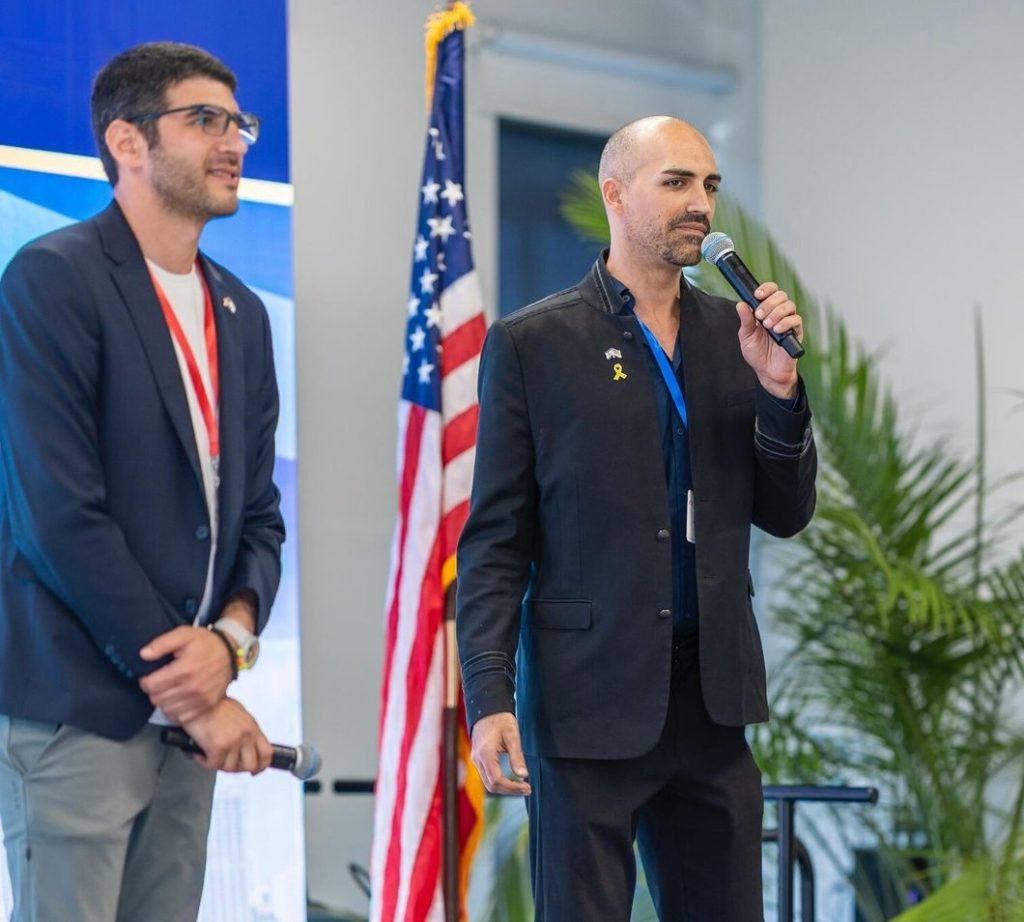
That’s where Israeli-born marketer Lior Halabi comes in. In mid-2023, he co-founded the Miami_Israel Collective with tech entrepreneur Ayal Stern, curating events to unite tech players. He’s gotten Israel Tech Week off the ground in Miami with tech entrepreneur Ayal Stern (also a co-founder of Miami_Israel Collective), partnering with dozens of other groups from South Florida and Israel, including the Miami-Dade Innovation Authority, FIBA, the American Jewish Committee, and Israel’s Export Institute.
“Miami is a good place for Israeli companies to find first clients and enter the U.S. market. It’s not like New York or California with an established ecosystem,” says Halabi, who came to South Florida a decade ago. “Here, new companies have a better chance to position themselves.” He aims to hold Israel Tech Week in Miami yearly and spin off smaller versions in U.S. tech hubs like Austin to help bring more participants to the larger Miami events later.
OVERCOMING OBSTACLES TO GROWTH
Of course, building tech links across oceans brings challenges. One common problem: how to structure international operations. Some Israeli companies silo their research and development activities in Israel and their sales in the U.S., but would benefit from better integrating both to scale-up, suggests Dvir Cohen, CEO of Momentis Surgical, who has been in South Florida since 2021. That means U.S. teams need to know the technology well and give feedback from customers about how they use it and their concerns.
“You need R&D boots on the ground in the U.S., as well as the right sales and marketing team in Israel, to build a strong foundation and really have a global business,” says Cohen, who has been in South Florida since 2021.
Then there’s the issue of new entrants finding partners in Florida. More major companies in Florida are now lending their expertise, including Mana Tech, part of the group led by Israeli-born, Miami-based real-estate developer Moishe Mana. The Mana group owns 72 buildings in downtown Miami and is creating an innovation district there to include offices, coworking spaces, research labs, and more.
For years, Mana Tech has assisted founders in Latin America to expand their businesses through Miami, organizing courses, workshops and meetings. Now, it has launched Miami-Tel Aviv 2025 to extend those efforts to Israeli ventures, building bridges to Miami and across the Americas. “We have the partnerships to make this happen,” says Mana Group executive vice president Yossi Harel.
To further strengthen the growing ties between Israel and South Florida, expect more conferences – in the vein of Israel Tech Week in Miami, which featured more than 15 events and 50-plus speakers.