


How Miami’s traditional banks cultivate their global clientele
Is Miami the banking capital of Latin America? “I’ve been saying that for 20 years,” says A. Alfonso Macedo, president and CEO of Miami-based Ocean Bank. “New York attracts ultra-high-net-worth individuals,” he allows, “but we understand their culture, how they think, their challenges. I believe they feel more comfortable banking with us. I’ve heard that over and over from our clients.”
Pedro Parra, executive vice president and head of international business at Amerant, is more than bullish on Miami’s increasingly palmy relationship to Latin America, citing the growing number of nonstop flights into Fort Lauderdale-Hollywood International Airport (in addition to Miami’s thriving international airport) from LATAM. To his point, Amerant is opening new branches in Downtown Miami and Key Biscayne, with another coming in Miami Beach. “The wealthiest Latin Americans used to have homes in New York, but that is shifting to Miami,” says Parra, who has been at Amerant for nearly a quarter century and has led its international banking section for the last two years.
Other traditional Miami banks that service a global clientele wholeheartedly agree with their assessment. Their mission: to cultivate and expand their international reach– and protect and grow wealth for their varied global clientele. As David Schwartz, president and CEO of the Financial and International Business Association (FIBA), points out, servicing foreign clients requires a level of expertise beyond what a bank needs for successfully dealing with domestic clients.
“We have a twofold mission,” Schwartz says of FIBA, a Miami-based non-profit trade association and international center. “And that’s education and advocacy. I think we’ve done a really great job educating our members on the latest changes, particularly in terms of regulatory compliance and cyber security. These are issues that impact them the most. I’m very proud, not only of what we’ve done as an organization, but what the members have done, the seriousness with which they’ve approached regulatory compliance.” Schwartz says the basics of compliance entail knowing your clients, their sources of wealth, and the source of the funds coming into an account. He says that banks must be vigilant to guard against any suspicious or illicit activity. Much is at stake: Failure to identify the source can lead to enforcement actions.
“There are a few banks in town that know how to [service foreign clients] fairly well,” says International Finance Bank’s President and CEO Abel Iglesias. “We’re one of them. We like to think that we’re the best, as it’s our day-to-day. It’s not all that we do – we have a domestic component that also does a very good job – but in the international realm, we’re known for understanding how to onboard international clients, which is not easy from a compliance standpoint, as well as adhering to a set of policies and regulations that we must follow.”
CATERING TO GLOBAL CLIENTS
Servicing global clients is not a one-size-fits-all proposition. Different Miami banks take care of their foreign clients’ interests in a diversity of ways, according to, among other variables, clients’ personal and business needs, their net worth, and their countries of origin. Pacific National Bank’s CEO and President Carlos Fernandez-Guzman explains that banking habits vary from country to country, noting that it is challenging, for example, to penetrate the Brazilian market. “Brazilians try to bank only with Brazilian organizations,” he says. “They tend to gravitate toward institutions and entities that are of Brazilian origin and have Brazilian management.” So which nations are most commonly represented among Miami banks’ clientele?
“We’re seeing a lot of growth from Argentina in terms of international deposits,” Macedo says. “And the Dominican Republic is booming. The country is becoming quite prosperous. Mexico is also growing very fast, as well as Chile and Colombia.” He says that high-net-worth clients from the Dominican Republic, Mexico, and Argentina are especially visible. “I always say that when Latin America does well, Miami does well, and when Latin America does bad, Miami does better. I believe they have their challenges with their local banks – their servicing is not the most efficient in the world. American banks service them a lot better, and they’ve noticed that.”

One common client narrative is that international visitors begin as depositors, and once trust is developed, banking activity grows from there. Jose Cueto, president of Grove Bank & Trust (at nearly a century old with its origins in Coconut Grove, it’s the longest-running bank in Miami-Dade County), notes that the lifestyle appeal of South Florida is what turns foreign nationals into depositors in the first place.
“We have programs for nonresidents who are coming to live in the United States, both on the commercial and residential side, and this reflects the attractiveness of living in South Florida,” he says. Cueto sketches out a typical sequence of events: “For example, it starts with a prominent real estate family in Argentina, and slowly they start investing in real estate in the United States – they want to diversify, they don’t want all their capital subject to sovereign risk – so they start investing in real estate. We can certainly help them with that, and then eventually they buy an apartment here for themselves and they live in it for half the year, and then a couple of years later they’re living here full time.”
INTERNATIONAL REAL ESTATE CLIENTS IN SOUTH FLORIDA
Ocean Bank’s Macedo also describes the ways in which foreign clients begin as simple depositors, and then their needs – which typically focus on real estate – dictate ensuing stages: “The next step is to finance whatever they’re trying to do,” he explains. “Sometimes they come in and buy a small apartment building and we finance it straight-up. Sometimes they buy investment properties in shopping centers. We have a handful of clients who have done some international trading. But, in general, the normal typical Latin American client likes to come in and invest in commercial real estate.”
Macedo says that Ocean Bank excels in construction loans. “We’re not seeing that much small business investment with the international clients,” he says. “Instead, usually they come in with their own capital and they initiate the business. After a couple of years, we finance the expansion of those businesses.” In terms of construction loans for international clients, “we force them to get a payment of performance bond from the contractors, to guarantee that the construction will be done correctly. We perform the inspection. So, we’re helping them through the construction process and have been very successful with international customers, especially when they come here to develop.” Ocean Bank, which was founded in 1982, is opening a new branch in Boca Raton, with another on deck in Doral.
Grove Bank & Trust’s program specifics are meant to ease the transition from visitors to banking clients. “We have residential lending products that are geared to second homes and investments for nonresidents,” Cueto says. “They have a particular set of structure pieces and conditions that are different from domestic client transactions. One of the characteristics is slightly lower leverage, plus reserves, which allows a foreigner to avoid coming into this country and buying a home with 100 percent cash, enabling them to be a participant in this real estate market.”
International Finance Bank’s Iglesias also emphasizes real estate activity. “We have clients that need to close on the acquisition of real estate. A lot of them bring capital into this country, particularly in South Florida, to invest in real estate either for themselves personally or for a commercial-type platform, and getting those funds to sellers, getting those funds to closing agents, moving that money to its rightful location – that is something we do every day.”
Miami encompasses a real estate landscape humming with activity, yet top bankers insist there’s a lot of money on the sidelines, with clients anticipating further interest rate cuts. The next few years are likely to experience more moving and shaking. “We’ve seen a little pickup in activity,” Cueto says. “I think there was around a 15 percent increase in applications nationwide and certainly we felt that here in South Florida [after the Fed started cutting rates]. I also think folks understand that this may be the first of many cuts. Many folks try to time this market, and there’s still a thesis that rates will go lower, and I think as they go lower, we expect activity to pick up with each subsequent cut.”
DIGITAL SOLUTIONS
International clients and digital banking are inseparable topics. Several top banking executives note that some countries – and their clients – demonstrate a sophistication in online banking that equals, or exceeds, that in the U.S.
“I think that the mistake we make in this country, and in banking in general, is to think that we’re more sophisticated than other banks in other countries,” says Iglesias. “The truth of the matter is that we’re not. The error that we could potentially be making is to think that level of sophistication doesn’t exist in our clients. It doesn’t matter if you’re in Peru or Ecuador or Guatemala, the digitalization is happening. In Spain or in Europe in general, I think it’s a lot more common than perhaps we give it credit for. The market is going to force you to move in that direction.”
Iglesias says that there are clients who are uniquely suited to take advantage of International Finance Bank’s digital rails. However, “others that are still not quite there. It depends on who you’re dealing with, depending on the country, depending on the generation. There are generations that still like working the traditional way through wire transfers, and we do a phenomenal amount of that volume. It’s the younger generations that are more adept in the digital world. They love using Zelle, for example.” Wire transfers just might soon be a thing of the past. “Twenty years from now, I think the wire transfer will go the way of the check,” he says. “The technology is certainly moving in that direction. I don’t think it will disappear completely. Especially when we’re talking about large sums of money, I think the wire transfer still offers you safety and security, because they’re traceable and a lot easier to recall.” Digital platforms, he explains, don’t offer that level of safety.
Cueto also emphasizes increased digitalization. “We have digital platforms and a lot of tools in place that will permit international clients to open accounts without ever having to physically come into a bank location, though we certainly want to meet with them. There are checks and balances and controls to enhance our need for due diligence and help us understand who these clients are. But, generally speaking, the days of international clients actually having to come into a bank to open an account — that’s not necessarily the way that banks operate anymore. Generally, most banks handling international clients are using digital platforms to enable the interaction with clients to be much more efficient and smooth – and less time-consuming.”
DIFFERENT STYLES OF BANKING
While global client comfort is near-universal as it regards digital banking, Pacific National Bank’s Fernandez-Guzman notes that international clients are discerning, with many enlisting different banks for different needs. “The international clients are very savvy for the most part, so they will tend to use the banks appropriately for liquidity that needs to be accessible and safe within the FDIC boundaries – and they can be protected beyond that with different programs that the banks have in hand. But clients also understand that they need to look at the brokers and other types of investment advisors to get a complete and total array of services; they’re not unidimensional at all.”
An à la carte mentality is typical. “Clients are discerning, based on best-in-class for each specific function,” Fernandez-Guzman says. “They will go to a trust entity for trust services, they’ll go to an investment house and brokerage operation for those services, they’ll use a bank for traditional banking services. They’re much more fragmented in that respect than an American consumer” who is more apt to use one bank’s disparate departments.
“There are levels of expertise that are specific to a function,” he adds. “Otherwise, it’s like saying, ‘I’m going to have my general doctor do heart surgery.’ We don’t have licensed personnel, so we don’t provide investment advice. We do not have a trust department, and that’s by design, because we don’t see our expertise as trust operations. We are true bankers that provide access to liquidity placement in the safest fashion possible with the highest possible return, but we don’t compete with the folks that are advising on stocks and bonds.” Fernandez-Guzman stresses Pacific National Bank’s liquid products: “Our money market high-interest checking accounts hover in the 4.75 percent to 5 percent range.”
Fernandez-Guzman says that in general, the most discerning clients are from Spain, and that Europeans tend to be more sophisticated than Latin American and Caribbean clients. Still, he praises the savvy of Argentine (“among the very top”), Chilean, and Colombian clients, as well as clients from Costa Rica and Panama. “In the old days,” he says, “Venezuela was among the top in the hemisphere. Today, not so much because of the condition of the country and the situation with the regulatory environment and how these clients are treated from a risk perspective.”
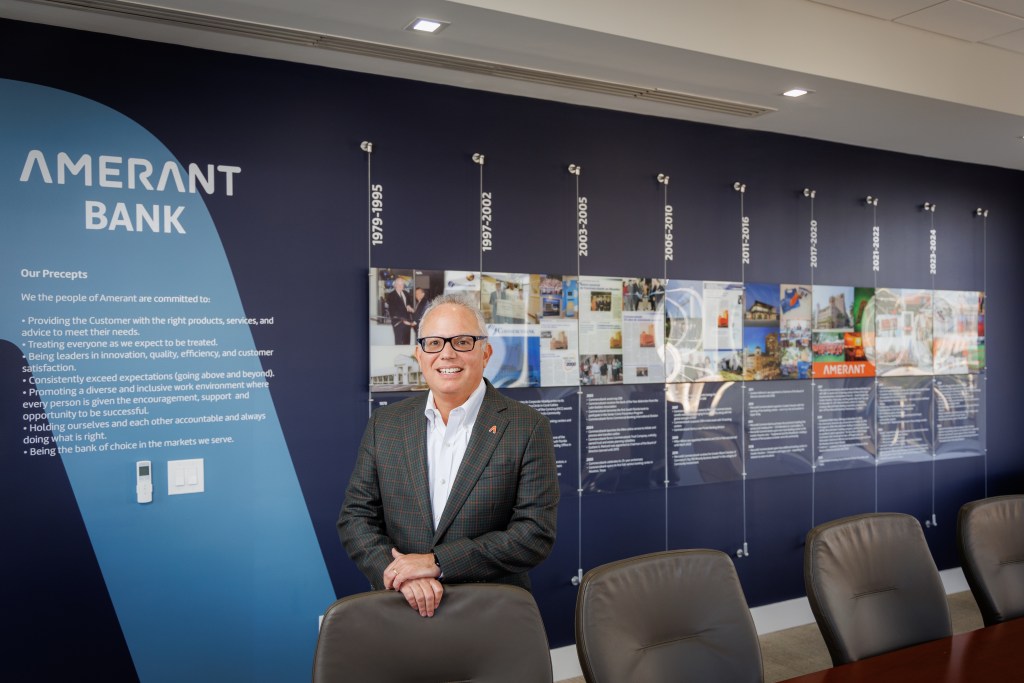
As Amerant’s Parra – who was born in Caracas – says, “Having been in this business for quite some time, we have come to understand their needs, but not every Latin country is equal, and not every Latin American is the same. But they have a common goal, which is to preserve their wealth and secure it with someone who understands their culture. And Miami is that.”



