Preparing for explosive growth, Miami International Airport (MIA) is undergoing a remarkable metamorphosis
Call it a classic case of growing pains. Miami International Airport has been growing by leaps and bounds for the last decade, resulting in last year’s record 56 million passengers and 3 million tons of cargo, making it the busiest international airport in the U.S. for cargo, and second only to New York’s JFK for international passengers. Last year, it saw more than 4 million new passengers and 250,000 more tons of cargo.
What hasn’t kept up is the physical infrastructure to accommodate that surge, in everything from aging escalators to shrinking parking capacity and limited cargo facilities. Even the bathrooms are becoming outdated, the quality of which is the top customer satisfaction metric among passengers.
That is all about to change — and just in time, with passenger flow expected to reach a staggering 77 million by 2040. By then, however, MIA’s ambitious $9 billion plan to transform itself will be complete. In a construction boom that is already underway, the airport is rolling out an ambitious series of upgrades and innovations that promise to reshape the travel experience for visitors and the flow of goods for shippers. From cutting-edge artificial intelligence solutions to more shopping options and expanded cargo facilities, MIA’s transformation reflects its growing status as a global aviation powerhouse and its critical role in the region’s economy, where it generates approximately $118 billion annually. The extensive changes represent a comprehensive effort to position MIA for continued growth in the decades ahead, with most projects due for completion over the next five years; the last of them – a new concourse that will alone cost nearly $1 billion – is set to finish by 2034.

INTERNATIONAL PRESENCE DRIVES MIA UPGRADES
Miami-Dade Mayor Daniella Levine Cava, a tireless advocate for airport upgrades, says MIA’s growth is directly related to Miami’s evolution as an international destination for visitors attracted by its culture, hotels, restaurants, and luxury lifestyle offerings, plus its recent growth as a financial and technology hub, along with international events like the World Baseball Classic, Miami International Book Fair, Latin Grammys, FIFA World Cup, Art Basel, F1 Miami Grand Prix, and Inter Miami CF captained by soccer GOAT Lionel Messi.
“We are emerging as one of the top three metros in the world, along with Dubai and Singapore. I call us `Paradise Rediscovered,’” says Levine Cava. “With that, we have an airport that‘s not brand new. We have other places that we’re competing within the world that have brand new airports, and none of them are growing at the pace we’re growing, at seven percent year-over-year.”
For both passengers and cargo, MIA enjoys an invaluable geographic location as the hub of the Americas. Over 60 airlines serve more than 180 destinations, and for many cities in Central and South America, it is easier to travel via a Miami connection than with a direct flight. The result is a huge economic impact. According to MIA Director and CEO Ralph Cutié, the airport generates about $118 billion in business revenue statewide, and about 700,000 direct, indirect, and related jobs across Florida. “So, what does that make us? Between passengers and cargo, we are not only the county’s but the state’s number one economic engine,” he says.

On the cargo side, Cutié points to Miami’s dominance in the perishables market as the secret sauce. “The perishables market is ours,” he says, “because, number one, we have unmatched cold storage facilities. We have about 466,000 square feet of cold storage facilities on property, and quite a few more off property, with dozens of freight forwarders and logistics operators nearby.”
To maintain its dominance, MIA has partnered with PortMiami to create a $79 million state-of-the-art phytosanitary treatment and cold chain processing facility at the airport to sanitize incoming perishables like flowers and fruit, and to provide cold storage for them. “Ninety-one percent of all the flowers that enter the United States come to this airport,” summarizes Cutié. “About 55 percent of all the fish, including salmon from Chile and other places, come through this airport. Sixty-five percent of all the fruit and vegetables that come into this country, come through this airport.”
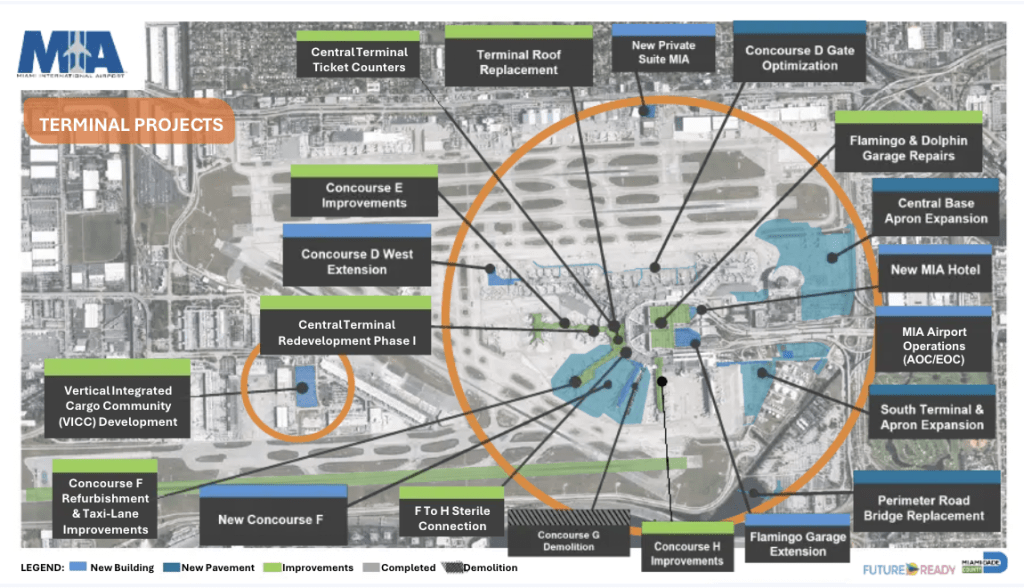
To continue flying in this rarefied air, MIA has undertaken a 10-year, $7.4 billion capital improvement program (CIP) to expand and modernize terminals and concourses, add gates, build new garages, and construct a vertical cargo facility. Add to that another $1.7 billion “Modernization in Action Plan” that will target deferred maintenance for infrastructure like roofing, elevators, escalators, moving walkways, and passenger bridges that connect the terminal to aircraft.
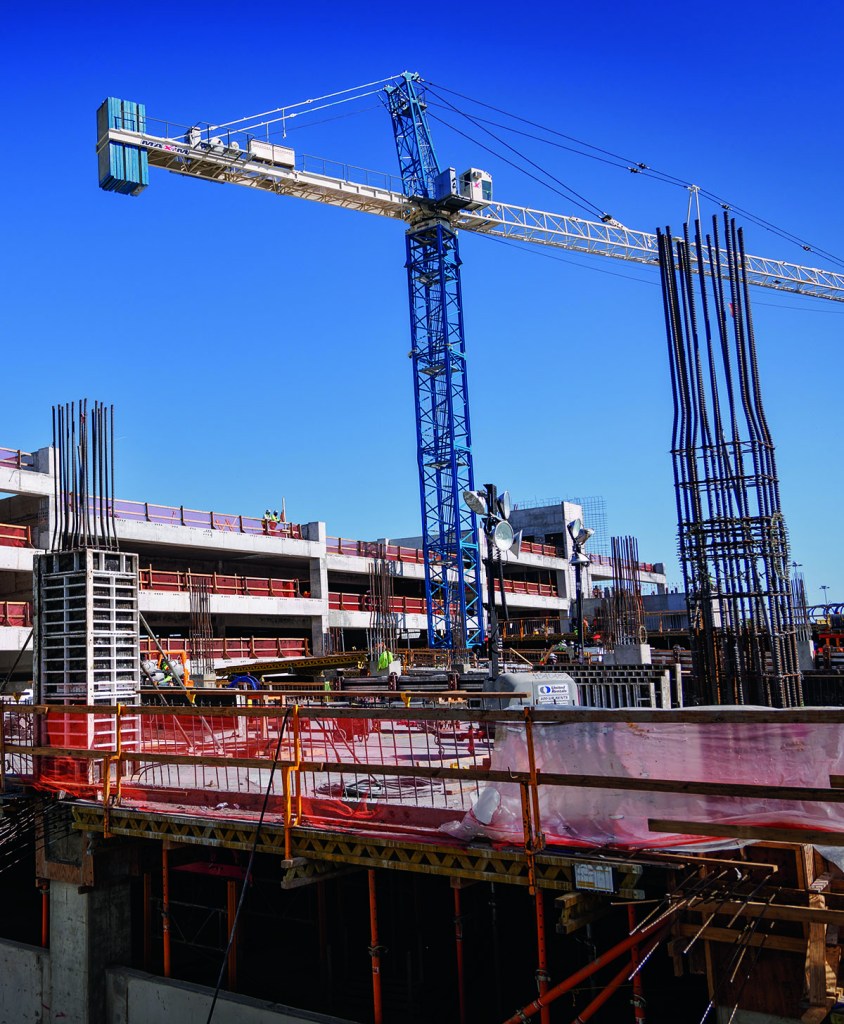
The airport’s latest infrastructure project, a $136 million parking garage expansion, broke ground in early 2024 and is set to augment parking capabilities when completed later this year. The ambitious seven-level structure will offer 2,240 parking spaces, including specialized accommodations for 34 oversized vehicles, 34 ADA-compliant spots, and 50 electric vehicle charging stations.

The new garage will seamlessly connect to the existing Flamingo Garage through dual vehicular and pedestrian access points on each level, and feature high-tech tracking systems to monitor traffic flow and elevator movement.
TECH INNOVATION TAKES FLIGHT
The garage extension is just the tip of the iceberg for tech enhancements at the airport. To accommodate growth, MIA is betting in part on technology sourced through the Miami-Dade Innovation Authority (MDIA), a program inspired by similar initiatives that Mayor Levine Cava discovered during a 2022 trade mission to Israel. MDIA will invest $100,000 in funding into each company to support testing their technology at MIA with the aim to scale these solutions to airports globally afterward. Maurice Jenkins, Chief Innovation and Customer Experience Officer at the Miami-Dade Aviation Department says MIA also conducted a successful trial of virtual queueing in 2022, allowing passengers to pre-schedule their Transportation Security Administration (TSA) checkpoint screening time, and is now working with TSA to get approval for deployment.
Another innovation is a new perimeter intrusion detection system (PIDS) which detects airport perimeter breaches in real-time. MIA is the first test site chosen by the Transportation Security Administration (TSA) for the system, which uses fiber-optic sensors, video surveillance, laser walls, ground-based radar, and AI analytics to monitor the airport perimeter. The TSA has already funded the installation of the system around 50 percent of MIA’s perimeter, with the remainder to be installed over the next two years. MIA is also partnering with the FTE (Future Travel Experience) Smart Ramp program to accelerate aircraft turnaround, where new autonomous digital technologies will be tested and shared with the International Airlines Group, says Jenkins.
With an eye toward improving passenger experience, MIA is focused on improving intra-airport conveyances and has allocated $681 million to that end. The challenge is that some transportation facilitators, like elevators, moving walkways, and escalators, require parts that are manufactured on demand. To avoid future supply chain bottlenecks due to wear and tear, MIA will use sensors to run these conveyances only when people are using them, instead of 24/7. By incorporating AI predictive technology, they hope to anticipate repairs rather than waiting for parts to fail. Bathrooms will also use real-time data to monitor the use of soap, paper towels, and other materials to avoid shortages and to direct janitors to clean spaces based on passenger traffic.
Jenkins is exploring additional strategies to improve customer experience, including augmented reality for navigating the terminal and biometric technology to make ticketing and security checks more efficient. One idea will make it possible for international passengers to have their baggage, already screened in London for example, travel directly to a connecting plane without having to check it in again.
Turning to the community at large for new ideas, the MDIA has for a second year issued an innovation challenge, ultimately selecting three cutting-edge companies from a pool of 136 applicants to test new concepts at MIA.

This year’s winners: Miami-based RouteMe, founded by local resident Dimas Lipiz, to offer an AI navigation system with audio, text, and touch assistance, including pre-visit virtual tours for anxious travelers; UK-based Signapse to provide real-time AI sign language translations, and Toronto’s Mapsted to bring advanced wayfinding technology to its first U.S. airport.
THE GROWTH DRIVING CHANGE AT MIA
Regardless of technology advances, the airport requires the brute force of sheer physical expansion to accommodate growth. The largest of such projects is the $746.4 million Concourse K Expansion, which breaks ground in the fall of this year. Slated for completion in Spring 2029, this essential project will enhance the airport’s capacity with six new domestic narrow-body aircraft gates and expand the post-security concessions area, offering travelers more dining and shopping options beyond the security checkpoint.

The numbers tell the story of why the airport needs to expand. In 2023, MIA shattered previous records with 52.3 million passengers passing through its terminals, marking a 3.2% increase from 2022. That surge was primarily driven by international travelers, with overseas traffic jumping 8.5% to 23.2 million passengers. While domestic travel saw a slight 0.5% decrease to 29.1 million passengers, this still significantly exceeds the 23.5 million pre-Covid domestic travelers recorded in 2019, demonstrating Miami’s enduring appeal as a destination despite increased competition from Europe, Asia, and the Caribbean.
Although all the numbers for 2024 are not in, overall traffic is expected to hit 56 million passengers. Cutié says that MIA has grown international travelers by 9 percent from 2023 and has seen growth of more than 120% since the pandemic when both domestic and international travel is combined.
American Airlines, the airport’s dominant carrier, played a vital role in this growth, serving 31.4 million passengers in 2023 and reaching an unprecedented 390 peak-day flights. Delta Air Lines has also expanded its presence, connecting Miami to every one of its hubs in the U.S., with 38 peak-day departures to 13 destinations. The arrival of new carriers such as Germany’s Condor Airlines and Spanish carrier LEVEL, further cements MIA’s position as a global connector. The airport is now home to an impressive roster of 94 passenger and cargo airlines.
As of the fourth quarter of 2024, there were 186 non-stop destinations served from MIA, with 79 in the U.S. (putting it at the top of U.S. airport rankings), 45 in the Caribbean and Bahamas (ranking it second), and 24 in Europe, the Middle East and Africa (ranking it third). If conversations turn into agreements, MIA could soon have a direct flight to Tokyo. First to take advantage of it could be Japan’s national baseball team, which won a third World Baseball Classic title in 2023 after flying a charter to Miami.
INFRASTRUCTURE UPGRADES
MIA has taken flak in recent years due to infrastructure snafus. But that is quickly becoming yesterday’s news. The Skytrain, for example, which serves passengers at 60 gates in Concourse D, closed in September 2023 due to cracks in concrete supports for the train. Three of four stations have since reopened and the fourth is scheduled to open this summer. The airport’s maintenance issues, including problems with elevators and escalators, prompted Mayor Levine Cava to address these concerns directly with new funding. “We had a period of time in which maintenance was not prioritized,” Levine Cava told Global Miami. “We have to make up for that lost time.”
Some help is on its way from the federal government. A recent $27 million federal infrastructure grant, part of a $1 billion national airport improvement initiative, places Florida at the forefront of aviation infrastructure development. The state received more funding than any other in this round, highlighting MIA’s strategic importance in the national aviation infrastructure. The funding will support two critical projects: $12 million for the Concourse E-Satellite people mover renovation, and $15 million for the Central Terminal ticket counter modernization. That is only a sliver, however, of the $1.7 billion “Modernization in Action Plan” to upgrade bathrooms, elevators, escalators, moving walkways, and passenger boarding bridges. MIA has 128 of these bridges, which are all being overhauled to accommodate glass walls that will provide easier maintenance for airport staff and stunning views of Miami for passengers embarking or disembarking from aircraft. And nearly 50 of the terminal’s 447 bathrooms have already undergone renovations as part of the program; all are scheduled to be upgraded for what Cutié calls “one of the first experiences for arriving passengers.”

The airport’s hospitality landscape is also set for a major upgrade with a new Westin hotel. The joint venture between Fontainebleau Development LLC, led by Jeffrey Soffer, and The Related Companies, chaired by Miami Dolphins owner Stephen Ross, won a competitive selection process to construct a new 520-room hotel connected to the North Terminal. The project represents a significant long-term investment, with the 50-year lease expected to generate $240 million in revenue for the county. The facility will offer a rooftop restaurant with 360-degree views, an outdoor pool deck, day suites for passengers resting only a few hours, and fitness studios.
CARGO CAPABILITIES & THE FUTURE
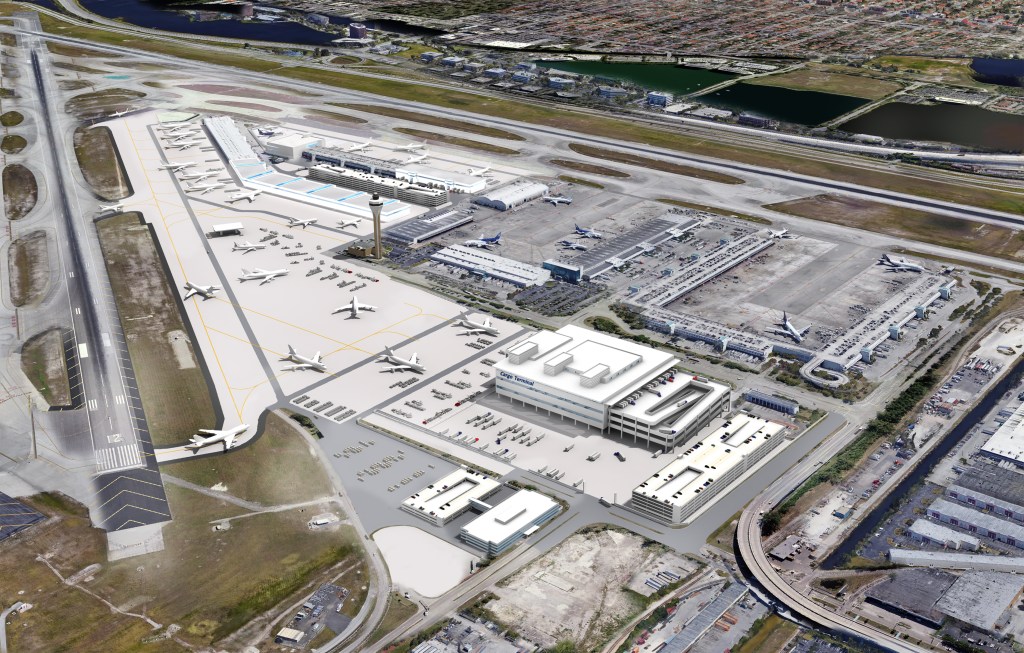
Last but not least, MIA’s cargo capacity, increasingly important to its success, will be addressed. A future four-story Vertically Integrated Cargo Community (VICC) planned by Miami Gateway Partners, LLC represents a bold bet on continued growth in this sector. This $400 million, 800,000-square-foot facility on 11 acres of airport land will increase the airport’s storage capacity to about 4.5 million tons, an increase of 2 million tons over current capacity. The project’s economic impact will extend beyond the facility itself. Under the 40-year lease agreement, Miami Gateway will pay at least $512 million in total revenue to the county. It’s also going to be a job creator: The development terms mandate that 60 percent of design and construction firms be headquartered in Miami-Dade, ensuring local businesses benefit from the expansion.
The cargo growth story is particularly evident in Latin American trade. LATAM Cargo’s decision to add routes between Miami and Brasilia, along with increased Miami-Florianópolis service, underscores MIA’s role as the airline’s biggest cargo market. DHL Express’s expansion into Argentina service, with aircraft capable of carrying 52 tons of cargo six days a week, further strengthens Miami’s position as a mighty logistics hub. Indeed, last year’s bounty of 3 million tons of cargo shipments broke the record again for MIA.
Miami International Airport’s transformation represents more than just physical changes to the facility, however. It reflects Miami’s evolution into a global city. The combination of technological innovation, infrastructure improvements, and expanded services reinforces MIA’s position as a key gateway between North America, Latin America, and Europe. From AI-powered navigation solutions to expanded cargo capacity, the changes at MIA blend innovation with the airport’s historic role in connecting the Americas.
As Cutié notes, these investments represent a generational investment designed to elevate the airport experience and its services for years to come. For the millions of travelers who pass through its terminals each year, these changes promise not just a more efficient and comfortable journey, but an experience that reflects Miami’s ambitious vision for its future.