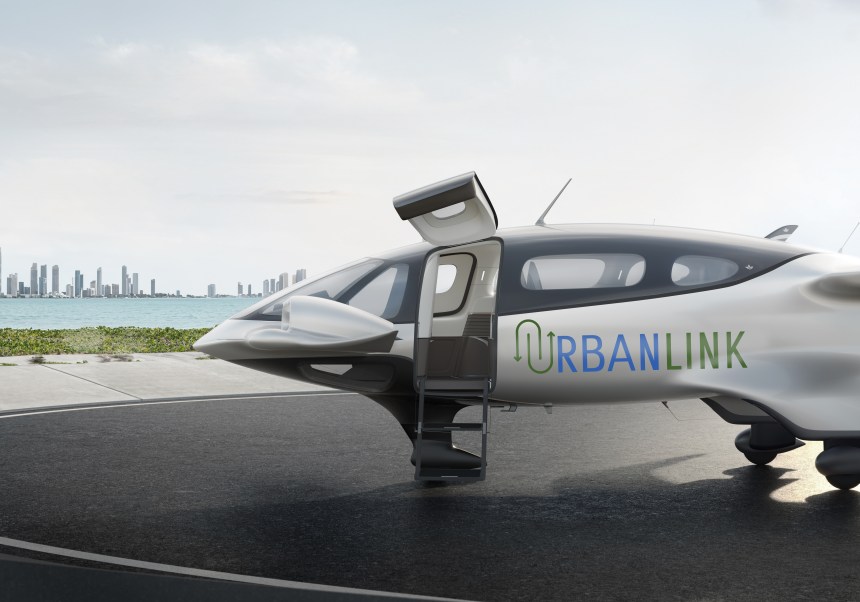
An Uber-like service with electric planes that take off vertically may soon become a reality in Miami
Anyone who has seen Sci-Fi movies like “The Fifth Element” or “Bladerunner” – or who read Popular Science or Popular Mechanics as a kid – may be wondering why our 21st-century skies are not filled with flying cars. Ed Wegel wondered the same thing. So, as founder and Chairman of Miami-based UrbanLink Air Mobility, Wegel decided it was time to become the first provider of advanced air mobility (AAM) solutions in an urban setting.
While the aircraft he will use – zero-emission electric vertical takeoff and landing (eVTOL) planes manufactured by German firm Lilium – look less like flying taxis than small jets, the concept is roughly the same. The idea is to quickly take local passengers from point to point in airborne craft.
Officially launched in May, Wegel envisions UrbanLink operating like an airline by the summer of 2026, with ticketing, security, and screenings. Planes would fly at up to 3,000 feet and travel at up to 180 mph. That would mean a 25-minute flight from Miami to Palm Beach. So far, UrbanLink Air Mobility has ordered 20 eVTOL craft from Lilium, each of which can carry six passengers at distances of up to 150 miles on one charge. The Lilium craft uses 36 ducted fans on wings that swivel to achieve vertical flight. “Cabins are very spacious, and it looks like an aircraft, which will be critical to public acceptance,” says Wegel.
UrbanLink has begun discussions with Miami-Dade County about constructing landing pads at Miami-Dade airports, including at Miami International and Opa-Locka, and has partnered with French infrastructure company Ferrovial and California-based Skyway Technologies Corp to build its vertiports, which eventually could sprout atop tall buildings or in surface lots. “We intend to expand rapidly once we establish our base in Miami, and we expect to operate from San Juan [Puerto Rico] as well as Los Angeles. We are also looking at Texas,” Wegel says.
“We’re incredibly excited to have UrbanLink as a customer, especially given that they are the first airline in the U.S. to fully commit to integrating eVTOL aircraft into their fleet,” said Matt Broffman, Lilium’s head of partnerships and public affairs for the Americas. “UrbanLink’s commitment to buy 20 Lilium Jets, with an option for 20 more, is one of the industry’s largest commitments by an operator.”
Wegel himself is a seasoned airline executive with over 40 years in airline financing, operations, and certification. He has led groundbreaking initiatives that have shaped the U.S. aviation industry, raising more than $1 billion for various ventures. (The start-up $2 million financing for UrbanLink is from Wegel’s aviation VC company Avi8 Air Capital, with more fundraising in the works.)
Among Wegel’s accolades: he introduced several new aircraft types into the U.S. market, including the Embraer E-145 and the Airbus A321 freighter; he spearheaded the privatization of Trinidad and Tobago’s national carrier; he served as the General Partner for Jetstream Air Lease, overseeing a $500 million commercial aircraft leasing fund; he co-created SCALE, the $2 billion aircraft leasing platform for Credit Suisse; and he was pivotal in formulating the initial business plans for JetBlue and Republic Airways.
As if the Sisyphean task of launching an urban electric plane service wasn’t enough, UrbanLink recently announced a partnership with Ireland-based Artemis to add carbon-free sea crafts to its transportation fleet. The entrepreneurial Wegel is also speaking to hospital networks like Jackson Memorial and Baptist Healthcare to create private-label emergency programs for Lilium aircraft to deliver transplant organs. “The potential is limitless, and we are committed to designing a network that will continually expand and grow as far as possible,” Wegel says.