Miami, Once a Food Shipping Hub, is now a Net Importer for Fruits and Vegetables from the Americas
A few decades ago, it was fruits, vegetables, and fish that went out, while medicines, medical products, and technological devices came in. Today, it’s the opposite. Miami’s exports have shifted toward high-value products, while imports predominantly consist of lower-value goods like produce.
Although Miami-Dade County still has abundant rural production, fresh fruit and vegetables grown in the area are mostly distributed locally or statewide. The heart of South Florida’s produce industry today revolves around trade with Latin America and the Caribbean. Miami’s ports act as a vital gateway for importing Latin American produce for distribution throughout the United States.
MIAMI'S AGRICULTURAL IMPORTS
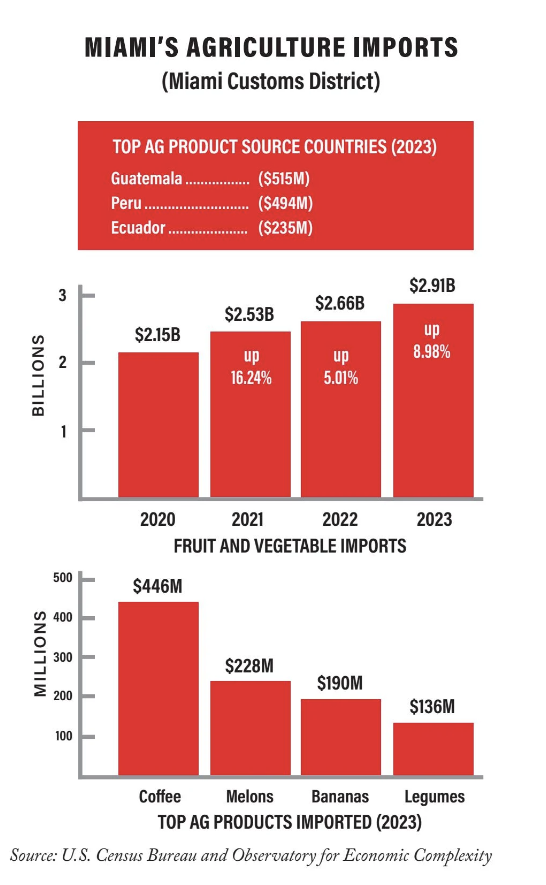
In 2023, the Miami Customs District exported $654M and imported $2.91B worth of fruit and vegetable products, with imports increasing 8.98% from the previous year. The top origin sources of these products were Guatemala ($515M), Peru ($494M), and Ecuador ($235M). Most of these products came from the region due to several factors, including proximity, seasonality, and logistics.
Geographical Proximity: Miami is geographically close to many countries in South America, Central America, and the Caribbean. This reduces transportation costs and time, making it more efficient to import fresh produce from these areas compared to more distant locations.
Climate Compatibility: Many countries in Latin America have climates conducive to growing a wide variety of fruits and vegetables year-round. This allows for a consistent and diverse supply of fresh produce that meets consumer demand.
Port Infrastructure: Miami has a well-developed logistics infrastructure capable of handling large volumes of perishable cargo. Miami International Airport (MIA) is the main point of entry for air perishables to the U.S. (accounting for approximately 70 percent of all U.S. perishable imports). PortMiami, meanwhile has invested billions in infrastructure improvements, including the Deep Dredge Project to increase channel depths and having more USDA staff than any other port of entry in the nation.
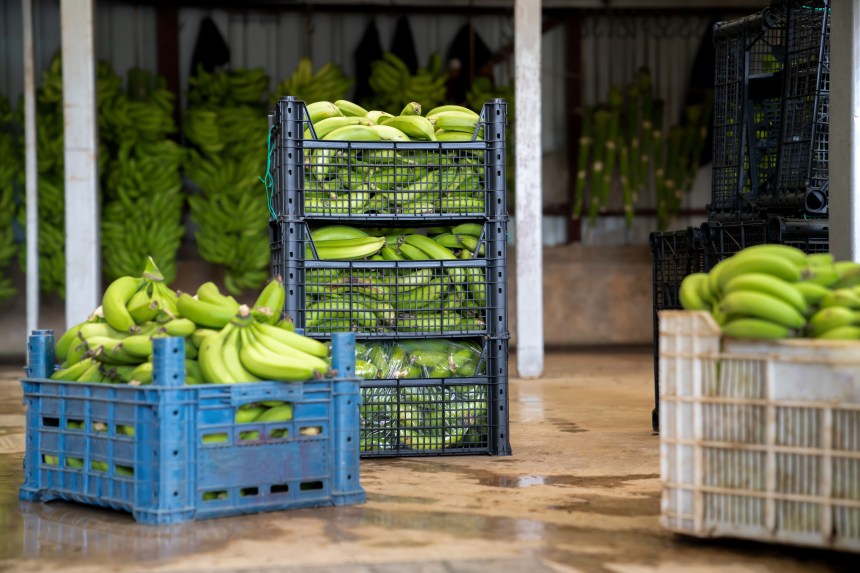
Products like bananas, pineapples, mangos, papayas, citrus fruits, tomatoes, cucumbers, peppers, asparagus, and avocados are commonly imported through Miami’s seaports due to their ability to last longer. MIA tends to import a broader range of perishable goods, including fruits and vegetables, but also seafood, flowers, and other high-value produce like berries and specialty fruits due to their perishable nature and the need for expedited transportation.
TOP IMPORTS IN MIAMI
The top imported vegetable and fruit products into the Miami Customs District are coffee ($446M), melons ($228M), bananas ($190M), and legumes (beans, peanuts, lentils, etc.) ($136M), much of it from Guatemala except for coffee. Contrary to popular belief, most of Miami’s coffee is not imported from Colombia but from Switzerland, which processes and packages the beans (think Nescafe and Nespresso); raw beans have historically arrived in the U.S. through New York, San Francisco, and New Orleans. Once in Miami, ag products are loaded and trucked to warehouses in the city of Doral for distribution throughout the U.S. and Florida. Doral has attained global status as Greater Miami’s logistics hub thanks to its significant refrigeration capacity and proximity to MIA.
Overall, Miami’s shift from an exporter to an importer of fruits and vegetables underscores the city’s transformation from an agricultural to a high-tech hub.