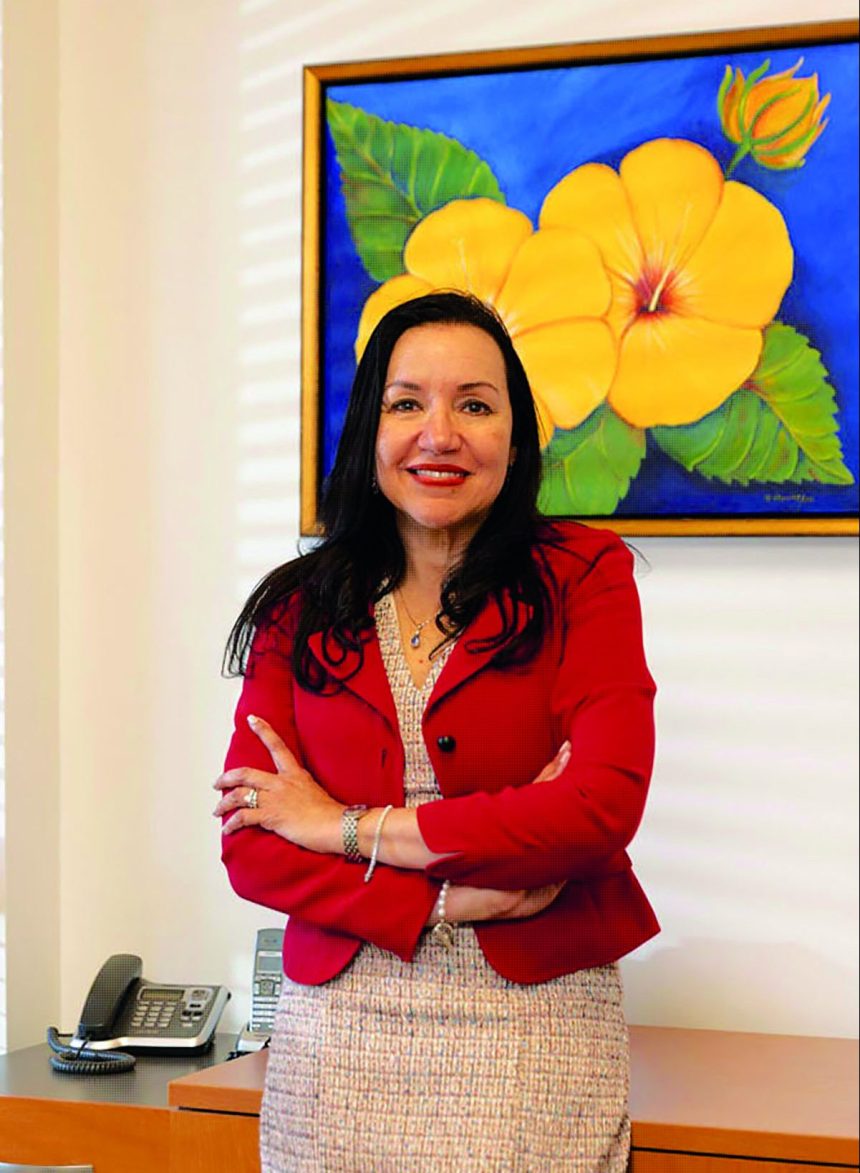
Daisy Ramos-Winfield and Florida’s Muscle for SME Exporters
When Vanessa and Mike Cantave launched their aircraft parts distribution company ten years ago, they clawed their way from $30,000 in sales that first year to $60,000 the next year. Then they met Daisy Ramos-Winfield, president and CEO of the Florida Export Finance Corporation, a not-for-profit created by the State of Florida to underwrite small and medium-sized exporters. After working with FEFC, sales at the Cantave’s Fort Lauderdale-based firm, 2Lyons Aerospace, jumped to $300,000 the following year then to $1.2 million the next.
“That first million was pivotal,” says Mike Cantave. “Because after that we were able to get additional financing. But without the FEFC there is no way we would have been able to get there… Daisy believed in us and took a chance.” This year the Cantave’s company is looking at $15 million to $20 million in sales.
Like other small exporters, especially new-to-market startups, 2Lyons Aerospace was stymied by limited access to trade finance. “Small businesses may not have the credit history or the years in business, or they may be new to exporting,” explains Ramos-Winfield, and so are declined by conventional lenders. “The FEFC becomes an option for these companies. We are considered the lender of last resort because we are the lender of last resort.”
The FEFC was launched in 1993 by Florida statute, with a mission “to expand employment and income opportunities for residents” by increasing the exports of goods and services. Its primary function is to provide financial assistance to small businesses – those with less than 250 employees and worth less than $6 million – along with information and technical assistance.
The muscle of the FEFC is its ability to guarantee up to 90 percent of the loan an exporter needs, money which is repaid after the company receives payment from an overseas client. “The purpose is to provide a bridge loan for the exporter to be able to finance their purchase orders while they are growing,” says Ramos-Winfield. “We work with a network of banks and non-bank lenders.”
If no bank will step up, even with a 90 percent loan guarantee, FEFC can provide a direct loan. “Maybe the bank is not interested in the amount, or in the country, or in the profit margins, which might be too low. So, we come in as the lenders,” says Ramos-Winfield, looking at details that don’t fit the typical qualifications checklist. “We look at the amount needed, the country, the industry, the course of repayment, and the expertise of the exporter,” she says. “Maybe they’ve been in business less than a year, with no credit history, but the executive has experience from an earlier career, or experience in the industry. We will work with items the banks just can’t.”
“We were exporting to emerging markets, where the credit ratings weren’t stellar,” says 2Lyons Aerospace president Vanessa Cantave, which dissuaded conventional lenders. But the FEFC relied on Mike Cantave’s years of experience as a pilot for various global airlines that would become clients for their aircraft parts. Now that they are a larger company with a proven track record, 2Lyons can access traditional trade-finance loans.
Since its inception, the FEFC has worked with 250 to 300 companies a year, facilitating more than $2 billion in loans over the last 30 years. They have helped finance exports of medical equipment, household goods, candles, meat, auto parts, construction equipment, oils and lubricants, industrial gear and, of course, aviation parts. They have also financed contracts for engineering and legal services. “There are a lot of ideas out there you wouldn’t believe,” says Ramos-Winfield.
“There is one company trying to export nondairy desserts. We looked at the industry, and it turns out there may be a market for them in Eastern Europe, where vegan desserts are popular.”