


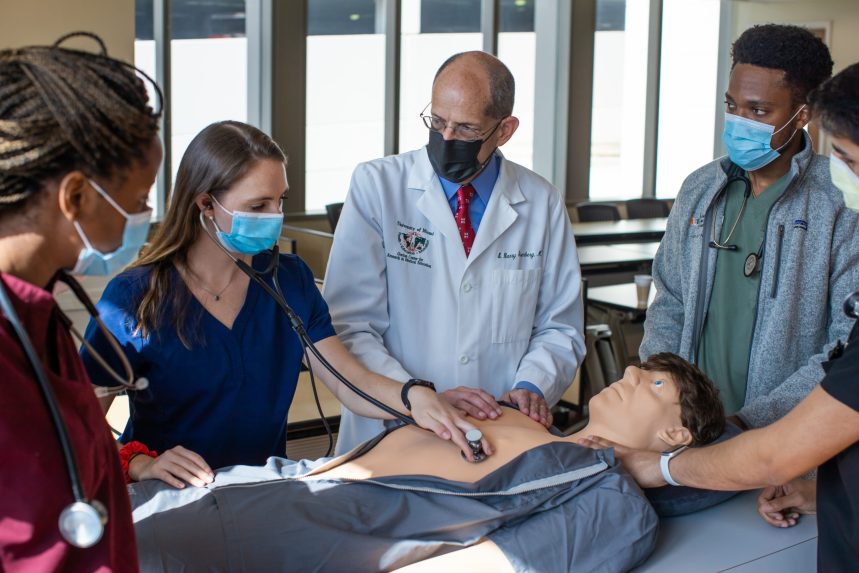
In 1968, Dr. Michael Gordon unveiled Harvey®, a 700-pound mannequin that would revolutionize medical education. For one of the first times in history, medical students could study the sounds associated with heart diseases in a reproducible classroom setting at the University of Miami’s “Simulation Center.” When students listened to a certain part of Harvey’s chest, they would hear the sound associated with a particular heart disease.
By today’s standards, the first Harvey seems archaic. At the time, however, it was cutting-edge technology that would inspire one of Gordan’s interns to expand the field of medical simulation technology. Today, the modern models of Harvey can simulate 50 patient scenarios ranging from pulmonary stenosis to heart failure, and it’s just one of the simulators at what is now called the Gordon Center for Simulation and Innovation in Medical Education. Among them are full-body simulators that can mimic childbirth and advanced trauma.
Much of the credit for the center goes – besides to Dr. Gordon – to Miami native Dr. Barry Issenberg. In 1982, when he was in just 8th grade, Issenberg began an internship under the direction of Gordon. He got to work firsthand with some of the latest medical simulation technology, and on weekends would go to the “Simulation Center” and record Harvey’s heartbeats on four-track cassette tapes for Gordan.
Fast forward 42 years. Gordon’s former high school intern, now a medical doctor, is the Gordon Center’s director. Each year, the center, and the simulators it exports to more than 60 countries, train more than 20,000 first responders and front-line clinical providers. The mission is straightforward: to save more lives.
According to a study by Johns Hopkins, medical errors occurring in a healthcare setting are the third leading cause of death in the United States. That’s right. Just after heart disease and cancer, medical mistakes are a leading cause of death. Issenberg says the medical simulation community can reduce those errors by better preparing future healthcare providers with more comprehensive training.
The Gordon Center uses two strategies. It develops, promotes, and exports advanced simulation technology like Harvey, and it creates a curriculum to use in conjunction with that technology. Part research institution, part publishing house, the Gordon Center is responsible for some of the latest medical instruction on emerging technologies. Issenberg says it’s not enough to just pioneer new teaching technologies like Harvey; there must also be a guide on how to use that technology.
“Without a curriculum, a piece of equipment will just be there installed in a room and won’t be used,” says Issenberg. “I mean, the curriculum is the common language for educators, both in medicine and in nursing, and it’s through that curriculum that we disseminate the technology.”

Issenberg says the traditional model of medical education follows students from the classroom to the observation of experienced practitioners, and finally to caring for patients. Simulation, he says, adds more low-stakes learning opportunities where medical students are allowed to make mistakes; future providers can experience more repetitions of a replicable situation before being thrown into patient care.
By combining its curriculum with simulation technology, the Gordon Center is impacting healthcare on a global scale. Harvey is now used in 56 countries, from Peru to the Philippines, and the Gordon Center’s partnership with multiple international universities has cemented its presence around the world. For example, through its Advanced Stroke Life Support® (ASLS) program and partnership with the American Heart Association (AHA), the Gordon Center has been able to use the AHA’s existing infrastructure to disseminate its stroke care curriculum. The international launch of its ASLS program recently took place in Dubai, and according to Dr. Ivette Motola, assistant director of the Gordon Center, representatives from more than 20 countries have since expressed interest in the center’s ASLS program.
Issenberg also hopes that his upcoming role as the president of the Society for Simulation in Healthcare will magnify the center’s global influence. According to Issenberg, it’s the largest international organization devoted to healthcare simulation, with members in approximately 80 countries.
“There’s no substitute for working with a real patient and learning about illness and how to manage that illness,” says Issenberg. “However, it was recognized that there were certain things that we do to patients – procedures, interventions – where you would not want to be that patient if the learner is doing that procedure for the first time.”



